




Organic Fertilizer Compost Turner
The OFEC Compost Turner (Organic Fertilizer Compost Turner) is the core machine for the fermentation stage. Through mechanical turning, it exposes the pile to sufficient oxygen, creating an ideal environment for aerobic microorganisms and accelerating the decomposition and transformation of organic matter. We offer three models – Hydraulic Compost Turner, Wheel‑Type Compost Turner, and Groove‑Type Compost Turner – each designed for different scales of composting sites and fermentation processes. They effectively solve common problems such as oxygen deficiency, uneven temperature, and excessively long cycles, significantly improving compost quality and yield.
Why Is the Fermentation Stage Crucial?
1. Harmless Treatment
Organic wastes often contain pathogens, parasite eggs, and weed seeds. The high temperatures (55–70°C) generated during composting effectively kill these harmful organisms, achieving safe, harmless treatment.
2. Organic Matter Stabilization
During fermentation, microorganisms convert readily decomposable organics into stable humus, eliminating odours, reducing volume and weight, and making the material easier to store and apply.
3. Nutrient Activation and Transformation
Fermentation gradually releases and transforms organic nitrogen, phosphorus, potassium, and other nutrients, improving fertilizer efficiency and crop absorbability.
4. Improved Physical Properties
After fermentation, the material becomes loose and has suitable moisture content, facilitating subsequent crushing, screening, and granulation – laying a solid foundation for the entire production line.
5. Shortened Production Cycle
Efficient turning significantly reduces the fermentation period – from 30–60 days in traditional composting down to 15–25 days – boosting equipment utilisation and overall capacity.
Hydraulic Compost Turner
Ideal for small‑ to medium‑sized composting sites and farm operations, this model features an advanced hydraulic control system, pull‑rod power steering, and crawler‑type running gear, offering excellent manoeuvrability and terrain adaptability.
Key Advantages:
● Hydraulically driven – smooth operation, precise control
● Crawler tracks – adapt to complex terrain, good flotation
● Even turning with no dead corners
● Simple operation and easy maintenance
Wheel‑Type Compost Turner
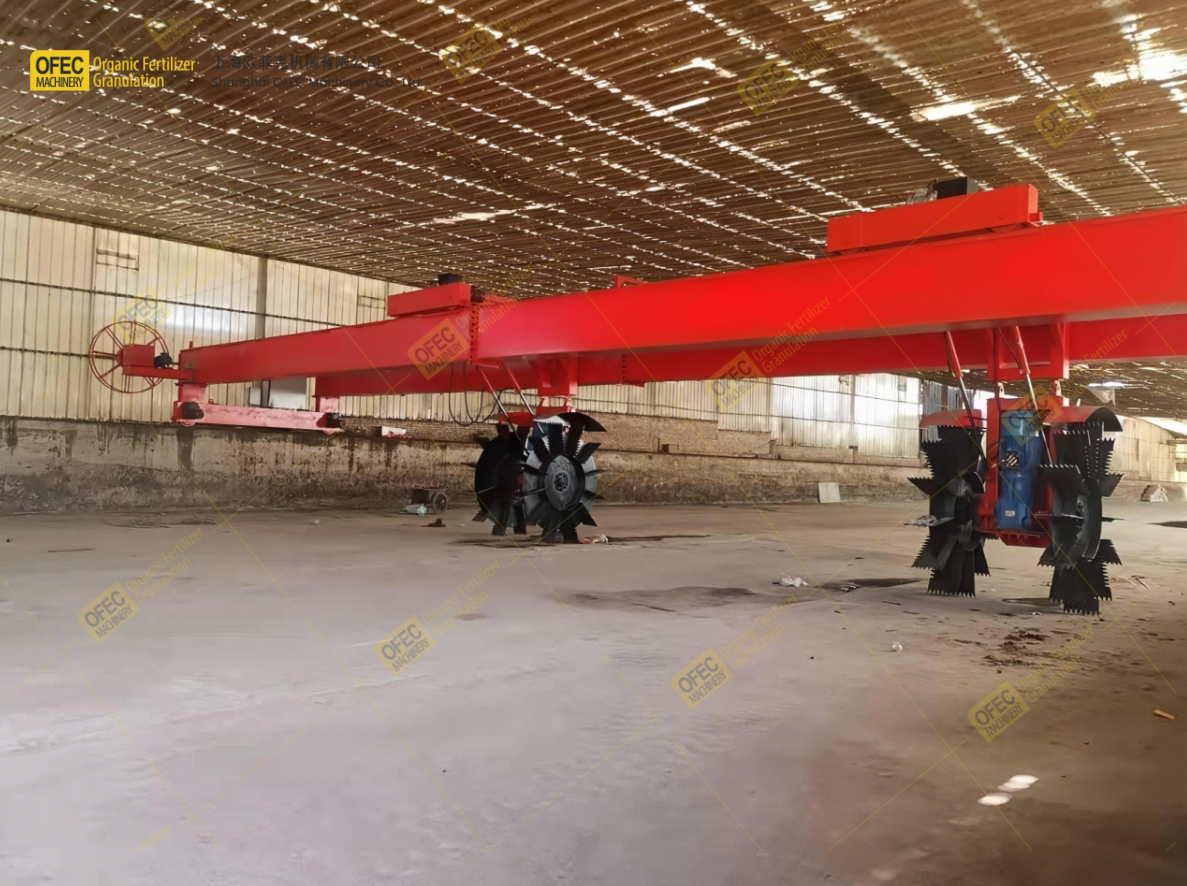
The wheel‑type turner is the top choice for large‑span, deep‑pile composting. It is designed for continuous operation in large‑scale facilities, with great turning depth and high processing capacity.
Key Advantages:
● Large‑span design – covers widths up to 30 metres
● Deep turning – up to 3 metres, ensuring excellent aeration
● High throughput – suitable for large‑scale continuous production
Groove‑Type Compost Turner
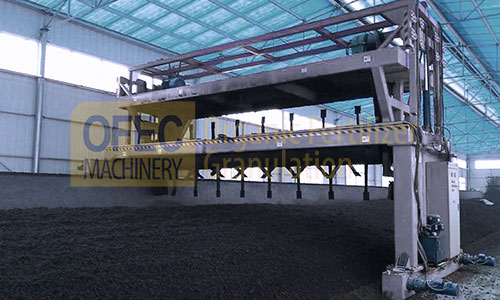
This turner is the core equipment for groove‑type aerobic fermentation systems. It can be used with a transfer car to serve multiple grooves, making it ideal for large‑scale, continuous composting processes.
Key Advantages:
● Groove structure – works with a transfer car for multi‑groove operation
● Even turning and thorough mixing – better fermentation results
● Optional hydraulic or mechanical drive
● Suitable for continuous feeding and discharging in mass production
Model Comparison Table
Comparison Aspect | Hydraulic Turner | Wheel‑Type Turner | Groove‑Type Turner |
Travel mode | Crawler | Rail | Rail / Wheel |
Suitable site | Small‑/medium‑sized farms, composting plants | Large composting plants | Groove‑type fermentation workshops |
Turning width | 2–3.5 m | 8–30 m | 3–6 m |
Turning depth | 0.8–1.2 m | 1.5–3 m | 0.8–1.2 m |
Processing capacity | Medium | High | Medium to High |
Terrain adaptability | Excellent – adapts to rough ground | Good | Limited – requires level ground |
Operational flexibility | High – free movement | High | Lower – needs groove system |
Typical applications | Farm composting, small‑/medium‑sized plants | Large organic fertilizer plants, sludge treatment plants | Large‑scale groove fermentation systems |
Recommended scale | Small‑medium (10,000–30,000 t/yr) | Large (30,000–100,000 t/yr) | Medium‑large (20,000–80,000 t/yr) |
Investment cost | Moderate | Higher | Moderate |
Rail
Rail / Wheel
2–3.5 m
8–30 m
3–6 m
1.5–3 m
0.8–1.2 m
Material Suitability Comparison
Material Type | Hydraulic Turner | Wheel‑Type Turner | Groove‑Type Turner |
Livestock manure (pig, chicken, cattle, etc.) | ● Applicable | ● Applicable | ● Applicable |
Crop straw | ● Applicable | ● Applicable | ● Applicable |
Municipal sludge | ○ Optional | ● Applicable | ● Applicable |
Sugar filter mud, distiller’s grains | ○ Optional | ● Applicable | ● Applicable |
Kitchen waste, herbal residues | ○ Optional | ● Applicable | ● Applicable |
Large‑span yard operations | ○ Optional | ● Applicable | ● Applicable |
Groove‑type fermentation system | — | ● Applicable | ● Dedicated |
Material Type
Hydraulic Turner
Wheel‑Type Turner
Groove‑Type Turner
Crop straw
Municipal sludge
○
○
○
○
●
●
● Applicable ○ Optional — Not applicable
How to Choose the Right Compost Turner?
Choose the Hydraulic Compost Turner if you
● Operate a small‑ to medium‑sized composting site or farm
● Have complex site conditions (uneven ground, tight spaces)
● Need flexible mobility and multi‑purpose use
● Have a limited investment budget and want quick start‑up
Choose the Wheel‑Type Compost Turner if you
● Run a large composting plant with high processing volumes
● Require wide‑span and deep turning operations
● Have an open, level site suitable for wheeled travel
● Process municipal sludge, industrial organic waste, etc.
Choose the Groove‑Type Compost Turner if you
● Adopt a groove‑based aerobic fermentation process
● Need continuous feeding and discharging for mass production
● Want to serve multiple grooves with one machine (using a transfer car)
● Have already planned a groove layout in your facility
For further evaluation of specific material characteristics and customized granulation solutions, please contact the OFEC technical team.
Resources
The Composting Plant’s “Space Magician” – Ferment More with Less Land
In organic fertilizer production, composting is the “first checkpoint” of
The “Productivity Engine” for Large-Scale Composting Facilities – How One Machine Supports a 100,000-Ton Annual Production Line
In organic fertilizer production, composting is the “first checkpoint” of