




Screening Equipment
Product Overview
In organic fertilizer production, material screening runs through the entire process flow, primarily including raw material pre‑screening and finished product grading.
Raw Material Pre‑Screening: Before raw materials enter the granulation system, significant variations in particle size can greatly affect pellet formation rate and uniformity. Therefore, raw materials must be pre‑screened before batching and mixing to remove oversized impurities and ensure a uniform particle size feed to the granulation system.
Finished Product Grading: After granulation, drying, and cooling, the semi‑finished organic fertilizer granules vary in size due to differences among granulation equipment and particle breakage during drying and cooling. This results in an uneven particle size distribution that does not meet finished product specifications. Screening is therefore essential to separate qualified granules (typically 1–6 mm) from unqualified fines and oversize particles. Some organic fertilizer manufacturers also require further grading of finished granules to meet different market or customer needs.
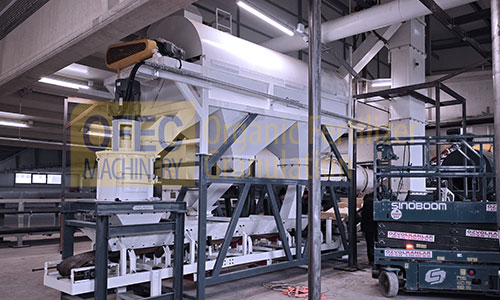
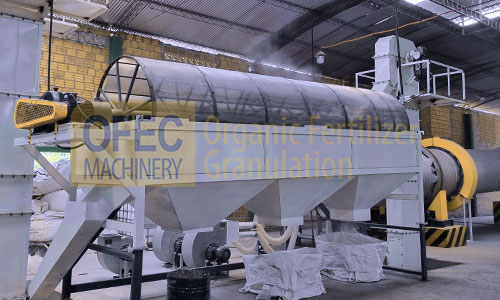
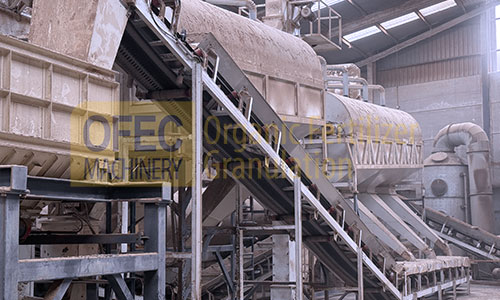
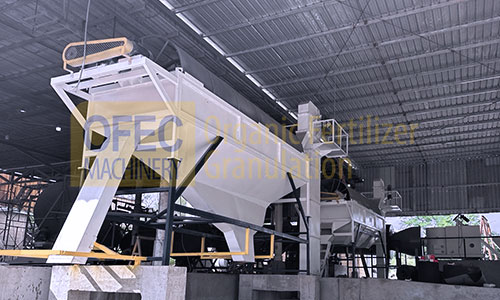
The OFEC Screening Equipment has become the most widely used screening equipment in organic fertilizer production lines, thanks to its simple structure, reliable operation, and high capacity.
Equipment Components
A – Frame: Supports the entire equipment
B – Feed Inlet: Entry point for material into the screen drum
C – Fines Outlet: Discharges undersize material (fines/returns)
D – Oversize Outlet: Discharges oversize material (coarse particles/returns)
E – Brush Holder: Secures the cleaning brush
F – Cleaning Brush: Cleans the screen mesh to prevent clogging
G – Screen Drum Assembly: Core working component
H – Bearing (Pillow Block): Supports the rotating shaft
I – Motor: Power source
J – Reducer: Reduces speed, increases torque
K – Guard Cover: Safety protection
Frame: Supports the entire equipment
Feed Inlet: Entry point for material into the screen drum
Fines Outlet: Discharges undersize material (fines/returns)
Oversize Outlet: Discharges oversize material (coarse particles/returns)
Brush Holder: Secures the cleaning brush
Cleaning Brush: Cleans the screen mesh to prevent clogging
Screen Drum Assembly: Core working component
Bearing (Pillow Block): Supports the rotating shaft
Motor: Power source
Reducer: Reduces speed, increases torque
Guard Cover: Safety protection
Working Principle
The screening equipment consists of a rotating screen drum assembly, a drive unit, and support structures. Its working principle is: the motor drives the central shaft through a reducer, causing the screen drum to rotate at a uniform speed in a circular motion.
Material enters the inclined drum from the feed end. Under the combined action of centrifugal force and gravity, the material rolls and falls along the drum wall, then is lifted again, creating a continuous tumbling motion. During this process, undersize particles pass through the screen mesh and are discharged from the bottom, while oversize particles move gradually along the inclined drum toward the discharge end. Through this process, the material is separated into three fractions – fines (returns), qualified product, and oversize (to be crushed and returned) – each collected and utilized separately.
Features and Benefits
Simple Structure
Stable Operation
Material Options
Easy Screen Cleaning
Precise Grading
Low Maintenance
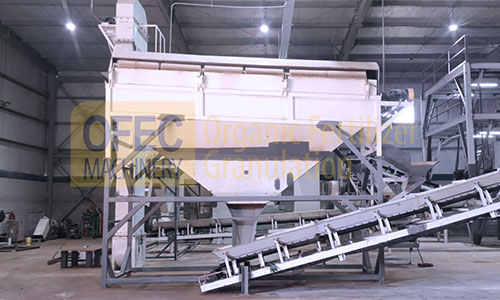
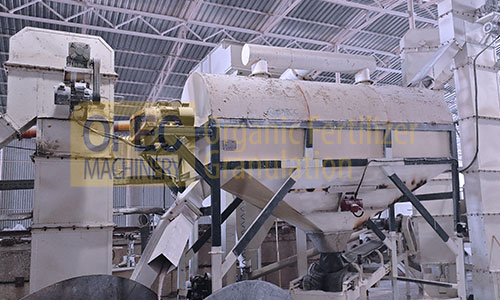
Industry Solution for Organic Fertilizer Screening Equipment
Screening is a critical quality control step in organic fertilizer production, directly affecting the appearance quality and market acceptance of finished products.
Typical Process Flow
Organic fertilizer granulation → Drying → Cooling → Screening → Coating (optional) → Packaging
Material Flow After Screening
● Fines (Undersize): Returned to the granulation system for re‑granulation
● Qualified Product (Mid‑size): Sent to coating or directly to packaging
● Oversize (Oversize): Crushed and returned to the granulation system
Solution Advantages
● Precise separation of qualified product from returns, ensuring finished product quality
● Effective recovery of fines and oversize, minimizing raw material waste
● Flexible grading to meet different market particle size requirements
● Quick screen mesh changes for smooth product specification transitions
● Stable operation supporting continuous production
Resources
The Overlooked Quality Gate That’s Quietly Eroding Your Profits
On an organic fertilizer production line, the granulator is the