




Batching System
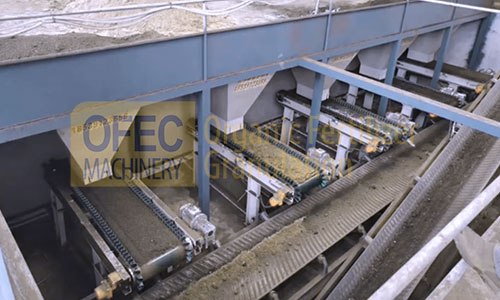
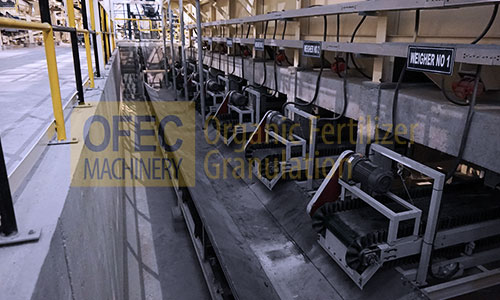
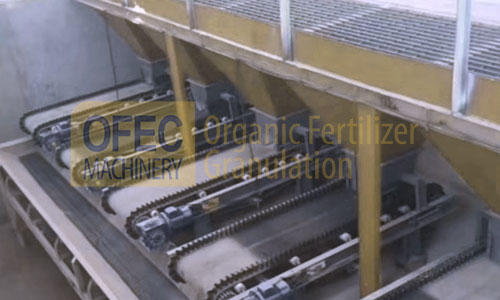
The OFEC Automatic Batching System is a continuous batching solution designed specifically for organic fertilizer production lines, suitable for precisely mixing, batching, and feeding 2–8 different materials.
Product Overview
The system employs dynamic weighing technology to continuously measure material weight during belt conveying and automatically adjusts the feeding speed to ensure accurate and stable proportions of all raw materials.
Equipment Components
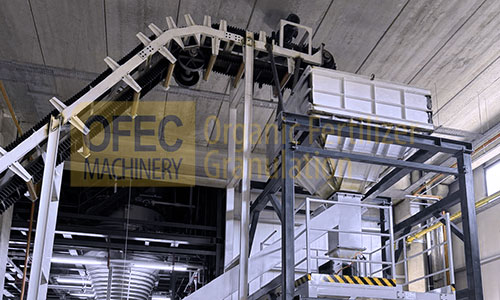
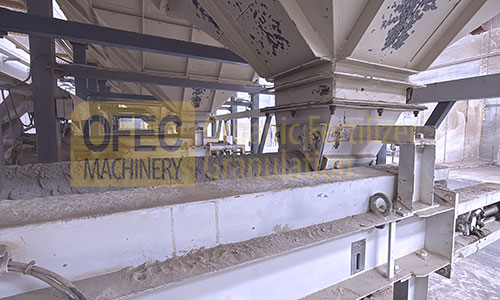
The automatic batching system mainly consists of the following components:
● Belt scale body
● Load cells
● Speed sensors
● Frequency inverter
● Motor
● Reducer
● Control instruments / PLC control system
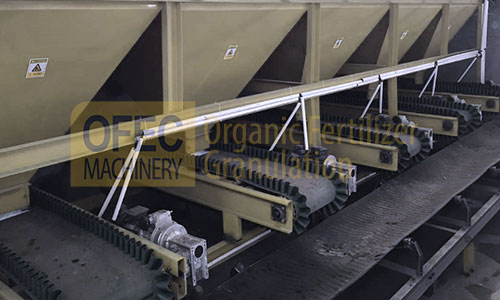
● Belt conveyor
● Hopper and feeding device
Working Principle
The automatic batching system operates on the principle of dynamic continuous weighing. During operation, load cells continuously detect the instantaneous weight of material on the belt, while speed sensors simultaneously measure the belt linear velocity. Both signals are processed by the control system, which then outputs a control signal to adjust the frequency inverter, thereby changing the motor speed and belt speed. This ensures that the actual feed rate continuously tracks the set value, achieving precise quantitative feeding.
The conveying capacity and accuracy of the batching system are closely related to material characteristics, belt speed, and other factors. When selecting equipment, parameters such as material name, particle size (mm), bulk density (t/m³), target flow rate (t/h), and site temperature should be taken into consideration.
Technical Specifications
Parameter | Details |
Number of Batching Materials | 2–8 types |
Weighing Method | Dynamic continuous weighing |
Control Accuracy | ≤ ±0.5% |
Single‑Line Feeding Capacity | 1–30 t/h (customizable) |
Belt Width | 500–1200 mm (customizable) |
Control Mode | Automatic / Manual switchable |
Installation Type | Above‑ground / Semi‑underground / Underground |
2–8 types
≤ ±0.5%
Industry Solution for Organic Fertilizer Batching
The batching system is a critical link that directly affects the quality stability of finished organic fertilizer products. OFEC provides customized batching solutions based on customer raw material types, formulation requirements, and target production capacity.
Typical Process Flow
Raw material storage → Automatic batching → Crushing & mixing → Granulation → Drying → Cooling → Screening → Packaging
Solution Advantages
● Optimized hopper and feeder design to prevent clogging, specifically addressing the high moisture content and variable flowability of organic raw materials.
● Supports rapid switching between multiple formulations to meet different organic fertilizer product requirements.
● Optional fully automatic control for seamless integration with the entire production line control system.
● Compact structure suitable for new plants or retrofitting existing lines.
● Reasonable investment, suitable for organic fertilizer projects of all scales.
Applicable Materials
Material Category | Typical Examples |
Organic Materials | Fermented livestock manure (pig, chicken, cow, etc.), straw powder, peat, humic acid, biogas residue, etc. |
Inorganic Nutrients | Urea, monoammonium phosphate, potassium chloride, ammonium sulfate, single superphosphate, etc. |
Fillers / Conditioners | Bentonite, vermiculite, perlite, etc. |
Material Category
Typical Examples
Features and Benefits
Flexible Batching
High Accuracy
Easy Recipe Adjustment
Compact Design
Low Energy Consumption
Simple Operation
Automatic Batching vs. Manual Batching
Comparison Aspect | Automatic Batching System | Manual Batching |
Batching Accuracy | High (≤ ±1%), stable and controllable | Low, significant human error |
Recipe Adjustment | Quick, changeable at any time | Slow, requires re‑weighing |
Production Efficiency | Continuous, no interruption | Intermittent, slows down entire line |
Labor Intensity | Low | High, requires multiple operators |
Product Quality Consistency | Excellent batch‑to‑batch consistency | High batch‑to‑batch variation |
Overall Cost | One‑time investment, long‑term returns | Rising labor costs over time |
High (≤ ±0.5%), stable and controllable
Excellent batch‑to‑batch consistency
Resources
Every 1% Increase in Batching Accuracy Rewrites the Destiny of Your Production Line
In organic fertilizer production, the granulator is the “heart,” and