




The OFEC groove-type compost turner product page lists its core parameters: trough-type fermentation structure, one machine serving multiple troughs with a transfer trolley, manual/automatic control modes, suitable for livestock manure / straw / sludge and various organic wastes. But the question worth exploring is not “how does this machine move?” but rather “how does the trough-type design push the ‘land efficiency’ of the composting plant to its extreme?”
1. Trough-Type Fermentation: Not Just “Digging a Trench” – It’s “Reconfiguring Space”
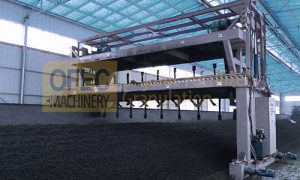
The fundamental difference between the groove-type compost turner and traditional windrow composting lies in the complete restructuring of space utilization logic.
Windrow composting requires large open areas – material is formed into windrows, and the equipment travels straddling the windrows, requiring space between piles for equipment movement and turning. For plants with limited land, this “spread-out” layout is often unsustainable.
Trough-type fermentation is fundamentally different. Material is concentrated in fixed fermentation troughs, and the equipment travels along rails on the trough edges. Troughs can be arranged closely together, eliminating the need for turning space between piles – significantly increasing land utilization.
Space efficiency comparison:
- Windrow composting: Approximately 0.5–1 m² per ton of material
- Trough-type fermentation: Approximately 0.2–0.4 m² per ton of material
This means: with the same land area, trough-type fermentation achieves 2–3 times the processing capacity of windrow composting.
2. One Machine, Multiple Troughs: One Machine Covers the Entire Fermentation Workshop
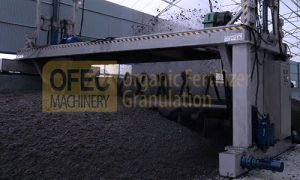
The most distinctive feature of the OFEC groove-type compost turner is its ability to serve multiple troughs using a transfer trolley.
In traditional trough-type fermentation, each trough requires its own turner – resulting in high equipment investment and low utilization. OFEC’s design philosophy is: one turner + one transfer trolley = coverage of the entire fermentation workshop.
How it works: After completing turning in one trough, the turner travels to the trough end, where the transfer trolley moves it laterally to the adjacent trough for continued operation. This cycle allows a single machine to serve multiple or even dozens of fermentation troughs.
The value of this design:
- Significantly reduced equipment investment: No need for a dedicated turner per trough
- Maximum equipment utilization: One machine operates round-the-clock without idling
- Lower maintenance costs: Only one main unit to maintain, not multiple
3. The “Hidden Advantage” of Trough-Type Structure: Exhaust Gas Collection Is No Longer a Problem
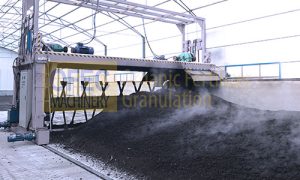
Another underestimated advantage of trough-type fermentation is the ease of exhaust gas collection and treatment.
Windrow composting is open – exhaust gases disperse directly into the air, making odor control the biggest environmental challenge. Trough-type fermentation is different: material is contained within the trough, and the top can be covered with gas collection hoods or membrane structures to capture ammonia, hydrogen sulfide, and other gases generated during fermentation for centralized treatment before discharge.
With increasingly stringent environmental requirements, this difference is becoming the deciding factor in whether a plant can operate normally. The groove-type turner not only solves the “turning” problem but also provides the structural foundation for “environmental compliance.”
4. Manual/Automatic Dual Mode: From “Experience-Based” to “Data-Driven”
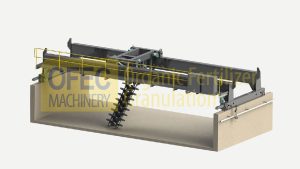
The OFEC groove-type compost turner is equipped with a centralized control cabinet supporting both manual and automatic control modes.
- Manual mode: The operator controls the machine’s travel, turning, and lifting actions directly through the control panel buttons – suitable for small-scale operations or the commissioning phase
- Automatic mode: The machine executes turning operations according to preset programs – the operator only needs to monitor status
The value of automatic mode lies in “standardization.” Turning depth, travel speed, and turning frequency can be precisely controlled, eliminating reliance on operator experience and condition. This means: every batch receives consistent turning, and batch-to-batch fermentation quality variation is minimized.
5. Groove-Type vs. Self-Propelled Windrow Turner: Not “Which Is Better” – “Which Fits Your Site”
| Comparison Aspect | Groove-Type Turner | Self-Propelled Windrow Turner |
| Land utilization | Extremely high (troughs arranged closely) | Lower (requires equipment access space) |
| Exhaust gas collection | Easily enclosed for collection | Open – difficult to collect |
| Equipment utilization | One machine serves multiple troughs – high utilization | Single machine serves multiple piles – high utilization |
| Initial investment | Medium (requires trough construction) | Lower (no civil works) |
| Flexibility | Lower (fixed trough structure) | High (free movement) |
| Suitable scenarios | Land-constrained, high environmental standards, large-scale production | Ample land, irregular site layout, flexible operations |
The essence of selection is not “which is more advanced” – it’s “what are your site conditions and environmental requirements?”