

Shanghai OFEC Machinery Co., Ltd.

Shanghai OFEC Machinery Co., Ltd.

E-mail: david@emccindustry.com

Contact Us

Home / Product / Organic Fertilizer Granulator / Roller Granulator

Roller Granulator

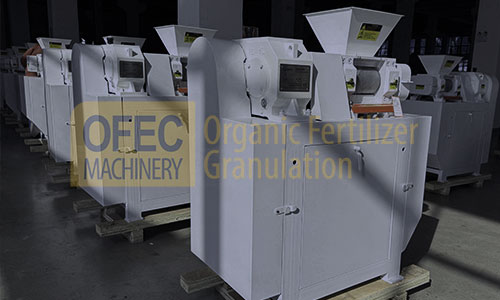
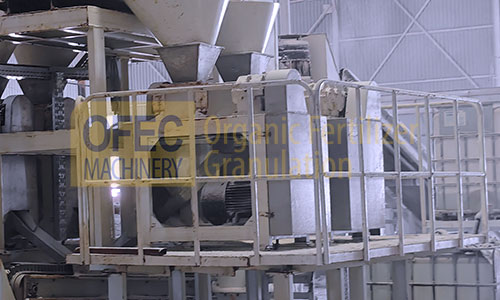
The OFEC Roller Granulator is the core granulation equipment for organic fertilizer production lines. Adopting a dry pressure granulation process, it is specifically designed for organic materials and energy‑efficient production. No drying required – one‑step forming with low energy consumption and high pellet strength. Single‑unit capacity covers 1–1.5 t/h, with parallel configuration support for larger throughput.

Product Overview

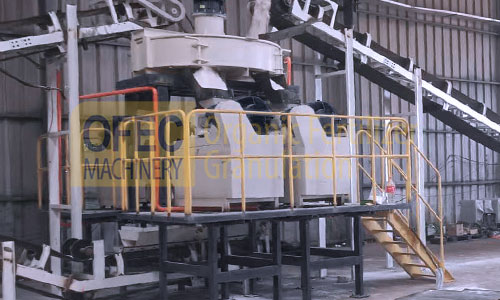
The Roller Granulator (also known as roll compactor or double‑roller granulator) is a dry granulation device – two counter‑rotating high‑pressure rollers compact powdered organic materials into dense, high‑strength pellets in a single pass at ambient temperature. This equipment requires no water addition or drying, making it especially suitable for heat‑sensitive organic materials (such as bio‑organic fertilizers containing microbial agents). It produces uniform, high‑strength columnar or irregular granules. Widely used in the fertilizer industry, it is particularly effective for granulating humic acid organic fertilizers, bio‑organic fertilizers, and similar products. With multi‑unit parallel configuration, it can also meet large‑scale organic fertilizer production requirements.
The OFEC Roller Granulator features a simple structure, easy operation, convenient maintenance, and high production efficiency.

Equipment Components

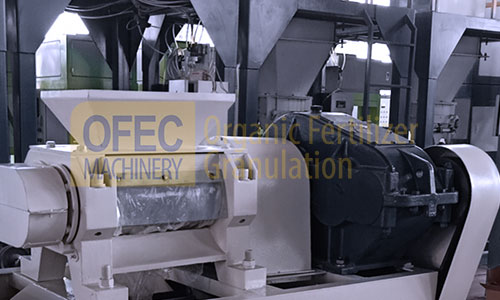
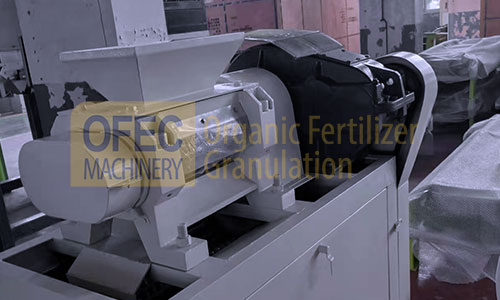
The roller granulator mainly consists of the following components:

A – Frame: Supports the entire equipment
B – Feed Inlet: Material entry point
C – Discharge Outlet: Discharges extruded material
D – Drive Cover: Safety protection
E – Gear Reducer: Reduces speed, increases torque
F – Coupling Guard: Safety protection
G – Granulating Unit: Core working component, including the roller assembly
H – Motor: Power source

  • Frame: Supports the entire equipment
  • Feed Inlet: Material entry point
  • Discharge Outlet: Discharges extruded material
  • Drive Cover: Safety protection
  • Gear Reducer: Reduces speed, increases torque
  • Coupling Guard: Safety protection
  • Granulating Unit: Core working component, including the roller assembly
  • Motor: Power source

Working Principle

The core of the roller granulator is the dry extrusion forming process. The working principle is: the motor drives a pair of counter‑rotating high‑pressure rollers, which force powdered organic material into a narrow nip gap. Under high mechanical pressure of 20–30 MPa, the material is compacted into dense, hard sheets. These sheets are then broken up by a flake crusher and screened through a sieving system to obtain uniform granules.

This process requires no water addition and no drying. The finished pellets have a moisture content of only 2%–5%, and overall energy consumption is reduced by 30%–50% – making it an efficient, energy‑saving, and environmentally friendly granulation method.

Technical Specifications

Model

Roller Diameter (mm)

Material Contact Surface

Capacity (t/h)

Power (kW)

Overall Dimensions (mm)

ZJY-136×200

136

Wear‑resistant Alloy Steel

1–1.5

15

1120×690×1400

Model
Roller Diameter (mm)
Material Contact Surface
Capacity (t/h)

Power (kW)

Overall Dimensions (mm)
ZJY-136×200
136
Wear‑resistant Alloy Steel
1–1.5
15
1120×690×1400

Note: The above are basic parameters for a single unit. For higher capacity, OFEC offers heavy‑duty models (single‑unit capacity up to 50 t/h) and multi‑unit parallel configurations. Custom specifications are available upon request.

Features and Benefits

No Drying Required
Ambient-temperature extrusion, one‑step forming, finished pellet moisture content only 2%–5%, protecting heat‑sensitive ingredients.
Eco‑Friendly & Zero Emissions
Dry process with zero wastewater, zero exhaust gas, and zero solid waste discharge – compliant with green production standards.
High Pellet Strength
20–30 MPa high‑pressure forming produces dense, strong pellets with a granulation rate exceeding 93%.
Compact Footprint
Single unit occupies only 2–3 m² – ideal for space‑constrained projects.
Fast Return on Investment
Eliminates drying and cooling equipment investment, low initial cost, short startup time – suitable for SMEs and start‑up projects.
Easy Operation & Maintenance:
Operable by 1–2 persons; maintenance mainly focuses on roller shells and bearings.

Applicable Materials

The OFEC Roller Granulator is suitable for granulating various organic fertilizer materials. Typical applications include:

Material Category

Typical Examples

Fermented Organic Materials

Fermented livestock manure (pig, chicken, cow, etc.), humic acid, bio‑organic fertilizer, biogas residue

Organic Wastes

Straw powder, peat, distiller’s grains, sugar filter mud, municipal sludge

Material Category

Typical Examples

Fermented Organic Materials
Fermented livestock manure (pig, chicken, cow, etc.), humic acid, bio‑organic fertilizer, biogas residue
Organic Wastes
Straw powder, peat, distiller’s grains, sugar filter mud, municipal sludge

Roller Granulator vs. Disc Granulator

Comparison Aspect

Roller Granulator

Disc Granulator

Granulation Method

Dry pressure forming

Wet agglomeration

Drying Requirement

No drying or only low‑temperature drying

Requires drying system

Pellet Shape

Columnar or irregular, high strength

Spherical, well‑rounded, moderate strength

Raw Material Moisture

2%–5% (optimal)

25%–35%

Energy Consumption

Low (saves 30%–50%)

Moderate

Equipment Investment

Moderate

Lower

Applicable Scale

Small to large (parallel configurable)

Small to medium

Environmental Control

Zero emissions, fully enclosed system

Open system

Microbial Survival Rate

>90% (cold granulation)

Affected by drying heat

Comparison Aspect

Roller Granulator

Disc Granulator

Granulation Method

Dry pressure forming
Wet agglomeration

Drying Requirement

No drying or only low‑temperature drying

Requires drying system

Pellet Shape
Columnar or irregular, high strength
Spherical, well‑rounded, moderate strength
Raw Material Moisture

2%–5% (optimal)

25%–35%
Energy Consumption
Low (saves 30%–50%)
Moderate
Equipment Investment
Moderate
Lower
Applicable Scale
Small to large (parallel configurable)
Small to medium
Production Flexibility
Zero emissions, fully enclosed system
Open system
Microbial Survival Rate
>90% (cold granulation)
Affected by drying heat

Resources

Scroll to Top