




Disc Granulator
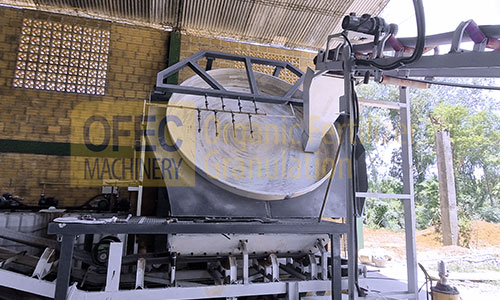
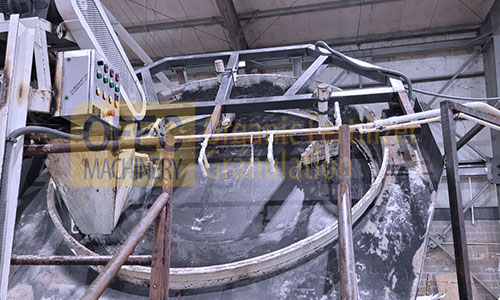
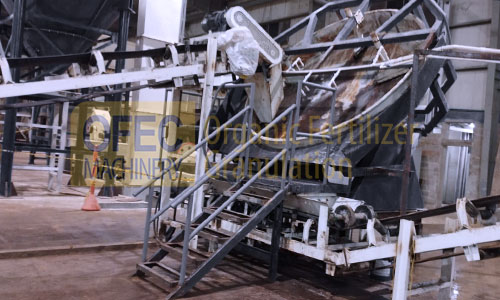
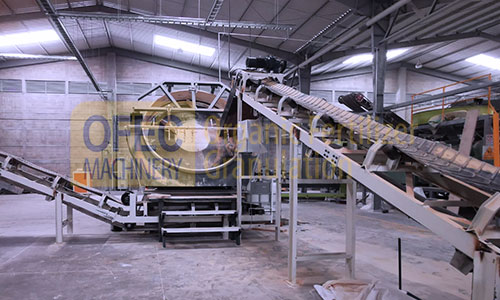
The OFEC Disc Granulator is the core granulation equipment in organic fertilizer production lines. Adopting a wet agglomeration process, it is specifically designed for organic fertilizer manufacturing and organic waste valorization. It delivers high pelletization rates, uniform spherical granules, and intuitive operation, with a single-unit capacity ranging from 0.1 to 15 t/h.
Product Overview
Equipment Components
The disc granulator consists of the following main components:
A – Mounting Base: Supports the entire equipment
B – Mounting Platform: Equipment installation foundation
C – Inclination Adjustment Device: Adjusts the disc inclination angle
D – Granulating Disc: Core working component
E – Scraper Holder: Secures the scraper
F – Scraper Assembly: Cleans the disc surface, prevents material buildup
G – Drive Shaft: Transmits power
H – Motor: Power source
- Mounting Base: Supports the entire equipment
- Mounting Platform: Equipment installation foundation
- Inclination Adjustment Device: Adjusts the disc inclination angle
- Granulating Disc: Core working component
- Scraper Holder: Secures the scraper
- Scraper Assembly: Cleans the disc surface, prevents material buildup
- Drive Shaft: Transmits power
- Motor: Power source
Working Principle
1. Nucleation: Dry organic powder is continuously fed onto the inclined rotating disc, while a measured liquid binder (water or organic binder solution) is sprayed through the spray system, forming small seed pellets.
2. Layered Growth: The formed seed pellets enter a continuous “forging” process through the complex motion of the disc, constantly absorbing new powder and being compacted layer by layer as they grow.
3. Automatic Classification: The most distinctive feature of the disc granulator – without additional screening equipment, it automatically separates qualified granules using the difference between particle gravity and centrifugal force.
Key factors affecting granulation performance include: disc diameter, inclination angle, rim height, rotation speed, feed position, and scraper position.
Applicable Materials
Material Category | Typical Examples |
Livestock & Poultry Manure | Fermented pig manure, chicken manure, cow manure, sheep manure, etc. |
Agricultural Straw | Corn straw, wheat straw, rice straw, etc. |
Organic Wastes | Municipal sludge, paper mill sludge, distiller’s grains, sugar filter mud, pharmaceutical residue, fermented food waste, etc. |
Other Organic Materials | Peat, biogas residue, humic acid, etc. |
Material Category
Typical Examples
Features and Benefits
High Pelletization Rate
Uniform Granules
Reasonable Structure
Low Energy Consumption
Adjustable Angle
High Efficiency
Easy Operation
Flexible Configuration
Wide Application Range
Disc diameters from 0.8 to 3.6 meters – meeting various organic fertilizer production scales.
Disc Granulator vs. Drum Granulator
Comparison Aspect | Disc Granulator | Drum Granulator |
Scale | Small-scale, flexible production (annual output ≤50,000 tons) | Large-scale, continuous operation (annual output ≥100,000 tons) |
Single-Unit Capacity | 0.5–1 5t/h | 3–30 t/h |
Equipment Investment | Lower | Higher |
Operating Cost | Lower – saves 15%–25% energy compared to drum granulator | Higher, but lower unit energy consumption at scale |
Material Adaptability | High-moisture, high-viscosity organic materials (fermented organic fertilizer, wet sludge, livestock manure, etc.) | Wide range of organic materials |
Pellet Shape | Spherical, well-rounded, moderate strength | Spherical/oval, higher strength |
Operation & Maintenance | Simple, intuitive, easy to maintain | Highly automated – requires trained personnel |
Production Flexibility | Very high – quick formula and parameter changes | Lower – suited for long-term fixed products |
Environmental Control | Open system | Closed system – easier dust and odor control |
Comparison Aspect
Scale
0.5–15 t/h
Equipment Investment
Operating Cost
Material Adaptability
Wide range of organic materials
Resources
A Machine That “Doesn’t Pick and Choose”
Among organic fertilizer granulation equipment, the disc granulator has one
Returning Organic Fertilizer Granulation to Its “Simple” Essence
Among organic fertilizer granulation equipment, the disc granulator stands out