




1. Simple Structure – Fewest Moving Parts, Fewest Failure Points
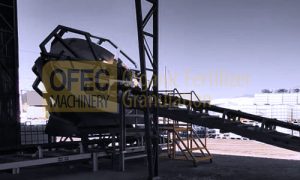
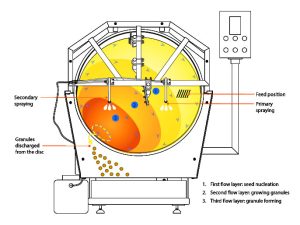
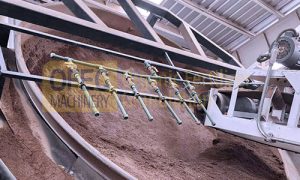
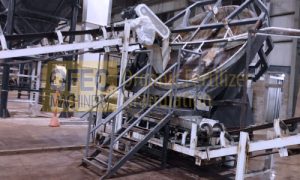
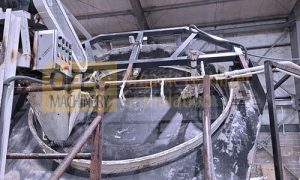
The structural design of the disc granulator is remarkably simple. The core configuration consists of only a motor-driven inclined disc, complemented by a feeding device, a liquid spray system, and a frame. The reducer and motor employ a flexible belt drive for smooth starting and impact reduction. The granulating disc bottom is reinforced with multiple radial steel plates for durability and deformation resistance. The thickened, heavy-duty base design even eliminates the need for anchor bolts.
Comparison of moving parts across granulator types:
| Comparison Aspect | Disc Granulator | Drum Granulator | Roller Granulator |
| Core moving parts | 1 (disc) | 1 (drum) + drive gear + roller system | 2 (rollers) + hydraulic system + feeding system |
| Sealing points | No pressure seals | Multiple seals at feed/discharge ends | Roller gap seal |
| Wear parts types | Scraper, liner (2–3 types) | Liner, lifting flights, gears, rollers (5–6 types) | Roller shell, hydraulic seals (3–4 types) |
| Hydraulic system | None | None | Yes |
| Automation dependency | Low (manual observation & adjustment) | High (PLC closed-loop control) | Medium (pressure monitoring) |
Equipment failure rates are positively correlated with the number of moving parts and sealing points. The disc granulator has no complex precision components, no high-pressure hydraulic system, and no frequently replaced dies – meaning the equipment’s failure rate is minimized to the greatest possible extent.
2. Simple Operation – Three Parameters, One Clear View
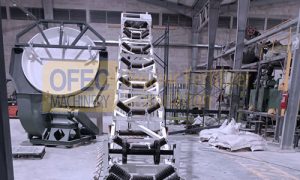
The disc granulator’s control interface is clean and intuitive, with only three core process parameters: disc inclination angle, rotation speed, and liquid spray rate. Operators do not require specialized mechanical or chemical knowledge – simple on-site guidance is sufficient to master pellet size control techniques.
(1) Inclination Angle Adjustment (35°–55°)
The disc inclination angle is the primary variable controlling pellet size. A smaller angle increases material retention time, resulting in larger pellets; a larger angle accelerates material discharge, shortening retention time and producing smaller pellets. In practice:
- High-viscosity materials (e.g., fermented manure): Use a larger angle (50°–55°) to accelerate discharge and prevent excessive agglomeration
- Dry materials (e.g., straw powder blends): Use a smaller angle (40°–45°) to extend retention time and promote pellet formation
Adjustment is simple – accomplished via shims or manual adjustment devices without specialized tools.
(2) Rotation Speed Adjustment (10–20 r/min)
Disc rotation speed directly affects centrifugal force and tumbling intensity. Excessive speed causes pellets to be thrown out prematurely and break; insufficient speed results in inadequate rolling and uneven growth. For a 2–3 meter diameter disc:
- Fine powders (particle size ≤1 mm): Higher speed (10–12 r/min) promotes frequent collisions for effective agglomeration
- Coarse particles (particle size 2–3 mm): Lower speed (8–10 r/min) prevents excessive friction and breakage
(3) Liquid Spray Rate Control
The spray rate directly affects agglomeration conditions and pellet strength. Insufficient spray prevents effective agglomeration, reducing the pelletization rate; excessive spray increases material viscosity, causing large lumps to form at the disc bottom. Key principles:
- Material moisture should be controlled within 25%–35%
- If pellets are loose and not forming, increase spray rate or speed
- If pellets are too large, increase inclination angle or increase speed
(4) Coordinated Logic of the Three Parameters
The three parameters are not independent variables – they operate with clear interrelationships:
- Inclination ↑5° → Speed ↑1–2 r/min: Maintains dynamic balance within the disc, preventing material accumulation
- Spray rate ↑ → Speed can be ↓: Wetter materials have higher viscosity and rolling resistance; reducing speed minimizes pellet breakage
- Raw material moisture changes → Prioritize spray rate adjustment, then fine-tune inclination
Operators can assess parameter matching in real time by observing the rolling state of material in the disc – smooth, uniform rolling indicates optimal conditions; flat or broken pellets signal the need for adjustment.
3. Simple Maintenance – Extremely Low Failure Rate, Controllable Maintenance Costs
(1) Routine Maintenance Tasks
Daily maintenance of the disc granulator is minimal, consisting of three primary tasks:
- Cleaning: Periodically remove residual material from the disc inner wall and accumulated material at the disc bottom
- Inspection: Check liner and scraper wear; replace when worn beyond limits; verify spray pipeline is clear; ensure all bolts are tightened
- Lubrication: Regularly check bearing housing temperature (should not exceed 60°C); replenish grease as needed
(2) Wear Parts Replacement Cycles
| Wear Part | Material | Typical Replacement Cycle | Factors Affecting Lifespan |
| Scraper | Wear-resistant alloy / ceramic | 2–6 months | Material abrasiveness, scraper material |
| Disc liner | Wear-resistant steel / stainless steel / FRP | 1–3 years | Material corrosiveness, wear intensity |
| Drive belt | Rubber | 1–2 years | Operating hours, load conditions |
The scraper is the most frequently replaced wear part. Ceramic scrapers can last over 6 months per blade tip, while standard material scrapers typically last about 100 days. Operators can determine replacement timing through visual inspection – no specialized diagnostic tools are required.
(3) Maintenance Cost Comparison
Compared to roller granulators requiring frequent replacement of expensive roller shells (costing thousands to tens of thousands of dollars per set) and drum granulators requiring complex transmission gear and seal maintenance, the disc granulator offers significantly lower maintenance costs. For a small to medium-scale organic fertilizer plant with annual capacity of 10,000–20,000 tons:
- Disc granulator: Annual wear parts replacement cost < USD 300
- Roller granulator: Annual roller shell replacement cost USD 2,000–5,000
- Drum granulator: Annual transmission and seal maintenance cost USD 1,000–3,000
4. Simple Installation – Modular Design, Rapid Commissioning
The disc granulator is also designed for installation simplicity:
(1) Lenient Foundation Requirements
Equipment employs modular design with minimal foundation requirements. The thickened, heavy-duty base eliminates the need for anchor bolts – the equipment simply needs to be placed on a level concrete floor. A foundation levelness tolerance of within 1/1000 is sufficient.
(2) Simplified Installation Process
The standard installation procedure consists of only three steps:
- Position the equipment on a level concrete floor
- Adjust verticality and horizontality
- Check reducer gear oil level and confirm correct disc rotation direction
(3) Plug-and-Play
Smaller models can even be moved flexibly – just plug in and start. No complex civil works, no auxiliary equipment installation, and no concrete curing period. For investors seeking rapid commissioning and early capital recovery, this “plug-and-play” capability means the timeline from equipment arrival to full production can be compressed to 1–2 days.
5. Technical Specifications Summary – Reliable Data Behind the Simplicity
Specification | Typical Value |
Pelletization rate | ≥93% |
Pellet uniformity | ≥98% |
Pellet size range | 2–8 mm (adjustable) |
Inclination range | 35°–55° |
Speed range | 10–20 r/min |
Applicable raw material types | 20+ types |
Single-unit footprint | 2–3 m² |
Scraper replacement cycle | 2–6 months |
6. Why Does “Simplicity” Matter So Much in the Organic Fertilizer Industry?
In the organic fertilizer industry, the majority of projects are operated by small to medium-scale farms, livestock operations, and startups. These projects commonly face three core constraints:
- Limited technical personnel: Cannot afford dedicated mechanical or automation engineers
- Constrained maintenance budgets: Cannot sustain high spare parts inventory or specialized maintenance costs
- Urgent commissioning timelines: Cannot wait through lengthy civil construction and installation cycles
The disc granulator’s simplicity – simple structure, simple operation, simple maintenance, simple installation – directly addresses these three constraints. It is not an industrial behemoth designed for maximum capacity and ultimate automation. Rather, it is a machine that returns organic fertilizer granulation to its “simple” essence – and this simplicity is precisely the pragmatic choice that small to medium-scale organic fertilizer projects need most.