




1. Production Capacity Advantage: One Set of Equipment, One Complete Line
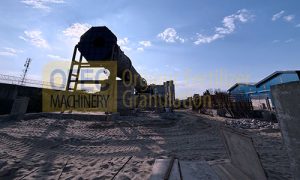
The most distinctive advantage of the drum granulation line lies in its capacity to handle an entire production line with a single equipment set. Unlike the disc granulator, which is limited to 0.5–5 tons per hour per unit, the drum granulator can achieve 5–20 tons per hour by adjusting drum length and diameter. This means that for medium to large-scale organic fertilizer projects, a single drum granulation unit can fulfil the granulation needs of the entire production line – eliminating the need for multiple parallel units (as required with disc granulators), which would increase equipment investment, complicate conveying systems, expand floor space, and multiply maintenance points.
Equally important, the drum granulation line supports 24/7 continuous operation. For large‑scale production, “continuous” means no idle equipment, no production stoppages, and no capital tie‑up. With smooth, reliable operation and a failure rate as low as 2%, this is truly an industrial‑grade system designed for “mass production.”
| Metric | Drum Granulator | Disc Granulator | Advantage |
| Single‑unit capacity | 5–30 t/h | 0.5–8 t/h | 4–10× higher |
| Continuous operation | 24/7 supported | Intermittent typical | Stable output, no downtime |
| Parallel configuration | Not required | Often needed | Lower investment, simpler layout |
2. Raw Material Adaptability: Stable Production Without Material Constraints
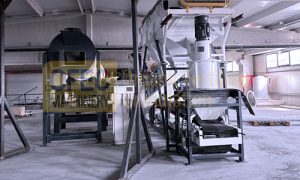
The biggest challenge with organic fertilizer raw materials is their inherent variability – different batches of livestock manure fluctuate significantly in moisture content and composition, and fibrous materials like straw can be a “nightmare” for traditional granulation equipment.
The drum granulator demonstrates superior “tolerance” in this regard. It can handle materials with moisture content ranging from 25% to 40% – a much wider window than the disc granulator’s 20%–30% range. Whether it’s fermented livestock manure, straw powder, sludge, distiller’s grains, or fungal residue, the drum granulator consistently delivers stable pelletization. For large‑scale organic fertilizer plants, this adaptability means no need to constantly adjust upstream fermentation processes to accommodate the equipment – production rhythm remains uninterrupted despite raw material fluctuations.
| Material Type | Drum Granulator Tolerance | Disc Granulator Tolerance |
| Moisture range | 25%–40% | 20%–30% |
| Fibrous materials (straw) | Excellent | Moderate (requires pre‑treatment) |
| High‑viscosity feedstocks | Good with steam/binder | Requires frequent scraper adjustment |
| Pre‑treatment required | Minimal | More critical |
3. Pellet Quality: The Hard Metric for Commercial Viability
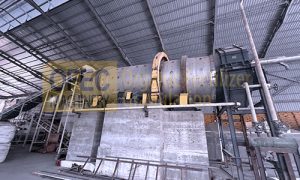
Organic fertilizer ultimately goes to market – pellet appearance, strength, and storage stability directly determine commercial value. The drum granulator produces pellets with a moisture of 15%-20% and precise particle size control within the 2–5 mm range. More importantly, pellet compressive strength can reach over 20 N, resulting in 15%–20% lower transport and storage breakage compared to disc granulator output.
For commercial organic fertilizer sold to end‑users, “transport durability” is as critical as “aesthetic appearance.” Broken pellets mean increased dust, nutrient loss, and customer complaints – hidden costs that multiply exponentially at scale. The drum granulation line provides a reliable solution precisely for this challenge.
| Quality Parameter | Drum Granulator | Disc Granulator | Advantage |
| Granulated Product Moisture Before Drying | 15%-20% | 25%–35% | Less drying cost |
| Compressive strength | ≥20 N | 10–15 N | 25%–40% stronger |
| Size control range | 2–5 mm | 2–8 mm | Tighter distribution |
| Transport breakage rate | 15%–20% lower | Baseline | Less dust, fewer complaints |
4. Operating Cost: The “Scale Effect” After Scaling Up
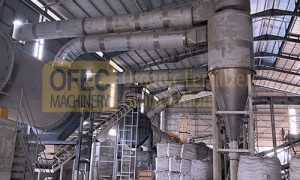
The initial investment for a drum granulation line is higher than that of a disc granulator. However, once production capacity crosses a certain threshold, the unit operating cost advantage becomes evident.
Energy perspective: The drum granulator adopts an energy‑efficient drive system, reducing energy consumption by over 25% compared to conventional granulation equipment.
Maintenance perspective: Equipment is designed for automated control, eliminating the need for frequent manual adjustments to inclination and speed. The failure rate is 40% lower than that of a disc granulator, and maintenance costs are over 30% lower.
Labor perspective: The entire line is highly automated, with minimal staff required for full‑scale operation.
Cost advantage threshold: For production lines with annual output exceeding 20,000 tons, these cost differentials translate directly into profit margins.
| Cost Factor | Drum Granulator | Disc Granulator | Advantage at Scale |
| Energy consumption | 25% lower | Baseline | Significant saving at high throughput |
| Failure rate | 40% lower | Baseline | Less downtime, higher OEE |
| Maintenance cost | 30% lower | Baseline | Lower spare parts consumption |
| Labor requirement | 1–2 operators per shift | 1 operator per unit | Lower headcount for same capacity |