




Traditional windrow composting requires 60 days to achieve full maturity. The hydraulic compost turner is compressing this cycle to 20–30 days – not incremental improvement, but a quantum leap in efficiency.
The OFEC hydraulic compost turner product page lists its core parameters: hydraulic operating system, crawler-type running mechanism, rod-type power steering, hydraulic automatic auger lifting. But the question worth calculating is not “how fast can this machine turn?” but rather “for every day the fermentation cycle is shortened, how much faster does the entire production line’s capital turnover become?”
1. The Essence of Turning: It’s Not About “Turning” – It’s About “Oxygen Supply”
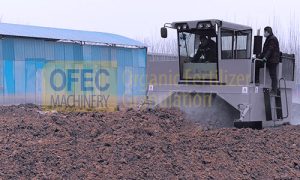
The core constraint of aerobic composting is simple: oxygen. Microorganisms inside the compost pile require a continuous supply of oxygen to decompose organic matter. Under natural conditions, oxygen within the pile is depleted within hours. Without regular turning, aerobic composting rapidly shifts to anaerobic fermentation – producing foul odors, stalling temperature rise, and allowing pathogens to survive.
The turner’s task is not merely to “turn the material,” but to reintroduce oxygen deep into the pile. A single effective turning cycle restores internal oxygen concentration from near zero to 10%–15%, sustaining aerobic microbial activity.
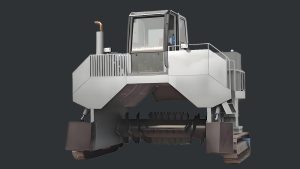
The OFEC hydraulic compost turner’s augers and mixing tools thoroughly turn and blend the material from beneath the frame, ensuring the pile is completely oxygenated from surface to bottom. The turned pile is loose, uniform, and significantly reduced in odor – with a seed germination index that fully meets organic fertilizer standards. This is not just “surface work” – it’s a complete oxidation reaction.
2. Crawler-Type Mobility: Not Just “Able to Move” – “Able to Move Anywhere”
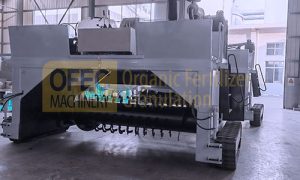
One of the most underestimated advantages of the hydraulic compost turner is its crawler-type running mechanism.
Compared to wheeled equipment, the crawler design provides superior ground traction, capable of handling soft, wet, uneven, and complex terrain (such as muddy areas and slopes) – preventing slippage with stability far exceeding wheeled equipment. This means:
- Rain is no obstacle: The machine continues operating despite standing water
- Muddy yards are no issue: Livestock manure composting sites are typically wet and slippery – the crawler-type turner is the only model that can operate reliably
- Seamless indoor/outdoor transition: The machine can move freely between workshops, greenhouses, and open outdoor areas
For farms and small to medium-scale composting sites with complex site conditions, crawler-type mobility is not a “bonus” – it’s a “requirement.” Without it, rain causes shutdowns, mud traps wheels, and indoor operation becomes impossible – each issue represents real production loss.
3. Hydraulic System: Not Just “Powerful” – It’s “Intelligent”
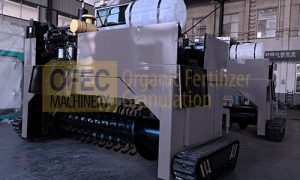
The hydraulic system of the OFEC hydraulic compost turner is not a simple “cylinder pushing cylinder” – it’s a complete precision-controlled power system:
- Hydraulic automatic auger lifting: Easily adjusts the distance between mixing tools and the ground based on different compost layer thicknesses
- Hydraulic automatic distributor lifting: Ensures convenient operation and high production efficiency
- Rod-type power steering: Simple operation that saves time and space
The value of this system lies in: the operator does not need to be a skilled driver. The rod-type steering wheel makes turning as simple as driving a tractor, and hydraulic lifting makes turning depth adjustment a matter of “pushing a button.”
A machine that does not require a professional driver means lower labor costs and faster operator onboarding.
4. Efficiency Comparison: One Machine Outperforms Dozens of Workers
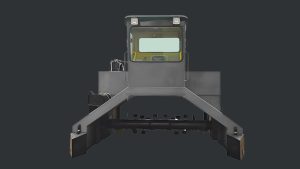
The turning efficiency gap multiplies significantly at scale.
| Turning Method | Daily Processing Capacity | Fermentation Cycle | Labor Requirement |
| Manual turning | Very low | 60+ days | Multiple people, multiple days |
| Loader turning | Moderate | 30–45 days | 1 person per machine |
| Hydraulic compost turner | High | 20–30 days | 1 person |
The hydraulic compost turner achieves turning efficiency over 80% higher than manual turning, with a daily processing capacity of 50–150 tons of material. This means: with the same site area and material volume, the hydraulic compost turner can shorten the fermentation cycle by over 50%-75%.
Reducing the fermentation cycle from 60 days to 20 days means:
- Faster capital turnover: Material residence time in the composting area is reduced by tw0-thirds
- Doubled site utilization: Annual throughput capacity doubles within the same footprint
- More flexible production planning: No longer forced to interrupt downstream processes due to extended composting cycles
5. The “Hidden Returns” of the Hydraulic Compost Turner: Labor Savings, Time Savings, Space Savings
The value of the hydraulic compost turner goes far beyond “turning the pile.”
Labor savings: One machine and one operator accomplish what previously required multiple workers. In an industry with rising labor costs, this is the most direct cost reduction.
Time savings: Reducing the fermentation cycle from 30-60 days to 20–30 days means the same site can process 4–6 additional batches annually. This is not just “efficiency improvement” – it’s capacity multiplication.
Space savings: A shorter fermentation cycle means less floor space occupied by piles. For plants with limited site area, this effectively means free additional production space.