




The E1 Fertilizer Production Station was designed to solve exactly this problem.
It doesn’t require you to become an equipment expert, spend months on equipment selection, or dedicate vast factory space. It compresses everything needed for an organic fertilizer granulation line into a compact, integrated station.
1. One Complete System – One Complete Production Line
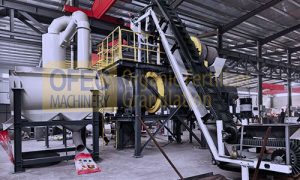
The E1 is not a single machine – it’s a complete granulation production line. From raw material feeding, drum granulation, drying, and screening to dust collection – all core processes are integrated into one system.
Traditional line setup involves sourcing feeders, granulators, dryers, screeners, dust collectors – each from different suppliers – then designing the layout, coordinating installation, and debugging interlocking controls yourself. This process takes months at best, often half a year or more.
The E1 approach is fundamentally different: it leaves the factory as a complete production line. No need to worry about equipment matching, no need to repeatedly adjust layouts – just plug in and start producing.
2. Capacity 0.5–1.5 T/H: Not “Small” – It’s “Just Right”
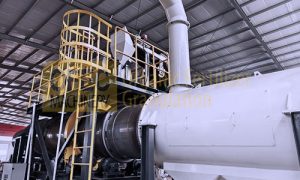
The E1’s capacity range of 0.5–1.5 tons per hour may seem modest for large-scale plants processing tens of thousands of tons annually. But for investors just entering the organic fertilizer market, it is precisely “just right.”
- Just right for market validation: No need to invest millions in a large-scale line from day one
- Just right for process development: 0.5–1.5 T/H is sufficient to test raw materials, formulations, and market response
- Just right for risk control: Smaller scale means lower investment and lower cost of trial and error
Solving all the challenges at a small scale first ensures smooth scaling later. The E1 is not designed to keep you small – it’s designed to help you gain large-scale experience at small-scale cost.
3. The “Counter-Intuitive” Advantage of a Combined Station: Constraints Can Be a Good Thing
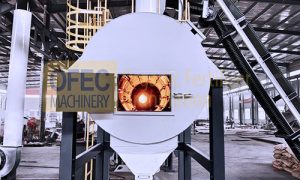
The E1 is a combined-structure system. Compared to modular lines, it offers less flexibility – equipment configuration is relatively fixed, and individual stages cannot be added or removed at will.
But this is precisely its advantage.
For startups, the biggest risk is not “lack of equipment flexibility” – it’s “not knowing what equipment is needed in the first place.” Faced with dozens of equipment options and countless permutations, most beginners cannot make optimal decisions – resulting in delayed selection, decision paralysis, and stalled projects.
The E1’s design logic is simple: it handles the “selection” process for you. It packages a proven, complete small-scale production line – you don’t need to become an equipment expert; you just need to decide whether to start. This “constraint” is essentially helping you bypass the biggest decision hurdle in equipment selection.
4. Low Investment, Fast Return: The Economics of the E1
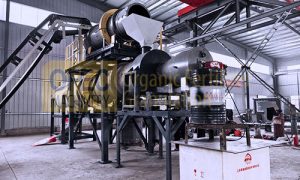
The core value proposition of the E1 can be summarized in one formula:
Low entry barrier + Fast market validation + Scalable upgrade path = Minimized risk
- Low entry barrier: Investment is far lower than traditional lines – no need to raise large capital
- Fast commissioning: Pre-engineered and pre-tested – shorter delivery and startup timelines
- Scalable: Additional equipment can be added as production capacity grows
For investors looking to enter the organic fertilizer market without going “all in” from day one, this formula means: achieving maximum market certainty with minimum initial investment.
5. Who Is the E1 For?
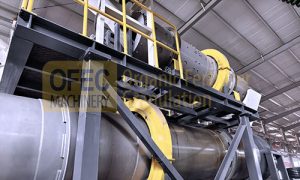
The E1 is not designed for large-scale plants – that is the domain of full-sized drum granulation lines. The E1’s true users are:
- Entrepreneurs preparing to enter the organic fertilizer market: Validate market demand and refine processes with a small-scale line
- Farm owners with livestock operations seeking on-site organic fertilizer treatment: Process self-generated manure into valuable fertilizer
- Companies wanting to conduct process testing before full-scale expansion: Collect data to inform design decisions for larger lines
- Investors with limited land and capital: The E1’s small footprint and low investment make it the optimal solution under space and budget constraints