




1. Large-Span Design: Not Just “Wider” – It’s “times Capacity”
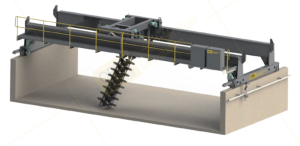
The most distinctive feature of the wheel-type compost turner is its large-span design – with a working width of up to 30 meters.
What does this “30 meters” mean?
In a composting facility, turning width directly determines the volume of material processed per pass. For a windrow of the same length, increasing turning width from 3 meters to 30 meters times the material volume processed per pass. At the same travel speed, daily processing capacity times.
The cascade effect of large-span design:
- Wider turning width → Fewer passes required → Shorter turning time
- Shorter turning time → Higher daily processing capacity
- Higher daily processing capacity → Faster compost turnover → Less land area required
For a composting facility processing 50,000–100,000 tons of organic waste annually, large-span design means accomplishing the same processing task with fewer machines, less time, and less land.
2. Turning Depth 1.5-3 Meters: Not Just “Deeper” – It’s “More Thorough”
The wheel-type compost turner achieves a turning depth of up to 3 meters.
Composting efficiency depends largely on whether oxygen can penetrate the entire pile. Traditional turning methods (manual or loader-based) typically achieve a turning depth of less than 1 meter – leaving the bottom layer as an “anaerobic dead zone” where temperature fails to rise, fermentation is incomplete, and pathogens survive.
A turning depth of 1.5-3 meters means:
- Piles can be built higher: Greater material volume per unit area, increasing processing capacity
- Complete oxygenation from bottom to top: Every layer of the pile receives oxygen
- More uniform temperature distribution: No “cold spots” within the pile – more thorough fermentation
The relationship between turning depth and capacity: Every 0.5-meter increase in pile height increases material volume per unit area by approximately 25%. With land costs rising daily, this difference directly determines the composting facility’s return on investment.
3. Wide Material Adaptability: Not Just “Able to Process” – “Able to Process Almost Anything”
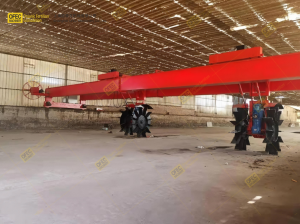
The OFEC wheel-type compost turner is suitable for livestock manure, municipal sludge, sugar filter mud, distiller’s grains, straw, sawdust, and various other organic wastes.
This wide adaptability is particularly valuable in large-scale production for a simple reason: large composting facilities typically receive diverse raw material sources – chicken manure today, sludge tomorrow, sugar filter mud the day after. If the equipment can only handle one material type, production planning becomes “held hostage” by raw material availability.
The wheel-type turner’s high-torque turning mechanism and deep turning capacity enable it to process high-moisture, high-viscosity, and high-fiber materials that are “difficult” to handle. This means:
- No fear of raw material variation: Differences between batches do not affect equipment performance
- No fear of high moisture: High moisture content of livestock manure and sludge is no longer a problem
- No fear of fibrous materials: Straw and sawdust structures do not cause clogging
4. The “Capacity Formula” for Large-Scale Composting: Efficiency × Depth × Width × Continuity
The value of the wheel-type compost turner can be understood through a simple “capacity formula”:
Capacity = Turning Width × Turning Depth × Travel Speed × Continuous Operation Time
Every improvement in each parameter represents linear capacity growth. The wheel-type compost turner achieves industry-leading performance across every parameter:
- Width: 8-30 meters (industry-leading)
- Depth: 1.5-3 meters (far exceeding traditional methods)
- Continuity: Round-the-clock continuous operation
The multiplicative effect of these four dimensions enables a single wheel-type compost turner to support 50,000–100,000 tons of annual composting capacity – this is not just “equipment selection” – it is capacity strategy.