




The OFEC combustion device product page lists its core parameters: compatible with coal/biomass/gas/oil and other fuel types, combustion efficiency up to 95%+, PLC intelligent control, heat output customizable from 500,000 to 20,000,000 kcal/h. But the question worth calculating is not “how much heat can this device generate?” but rather “how does the choice of combustion device determine the long-term operating cost of the drying stage?”
1. Drying Costs: The Production Line’s Biggest “Fuel Drain”
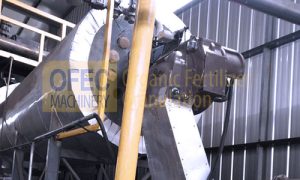
In organic fertilizer production, drying is the most energy-intensive stage. A rotary dryer consumes 50%–70% of the plant’s total energy. This means: for every $100 of fuel burned, $50–$70 is “consumed” by the dryer.
As the heat source for the dryer, the combustion device’s efficiency directly determines how much of that $50–$70 is effectively utilized and how much is wasted.
- Combustion efficiency 95%+: For every $100 of fuel, over $95 is converted into usable heat
- Combustion efficiency 80%: For every $100 of fuel, $20 is effectively “burned” into the air
The efficiency gap appears to be only 15 percentage points – but on a 50,000 t/y line, this difference means tens to hundreds of thousands of dollars in annual fuel cost variance.
2. Fuel Selection: Not “What Can Be Burned” – “What Is Most Cost-Effective”
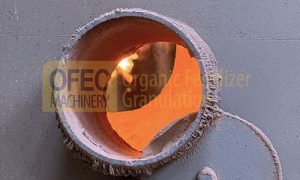
The OFEC combustion device is compatible with coal, biomass, gas, oil, and other fuel types. This “flexibility” is not an added bonus – it is a core decision variable that directly affects long-term operating costs.
| Fuel Type | Unit Heat Cost (Relative) | Suitable Scenario | Key Considerations |
| Natural gas | High | Areas with pipeline coverage | High price volatility, affected by international gas markets |
| Oil | Very high | Temporary/backup heat source | Highest long-term operating cost |
| Coal | Low | Traditional coal-burning regions | Increasingly strict environmental restrictions |
| Biomass | Medium | Regions rich in agricultural/forestry waste | Supply stability must be assessed |
In regions where natural gas prices are high, switching to biomass can reduce fuel costs by 30%–50%. But this choice is not “once and done” – biomass fuel supply stability, storage conditions, and combustion efficiency must all be evaluated.
The combustion device’s “compatibility with multiple fuel types” is not a slogan – it is a strategic capability that allows the plant to switch fuels flexibly based on local energy prices.
3. Direct-Fired vs. Indirect-Fired: Two Choices Behind 95%+ Thermal Efficiency
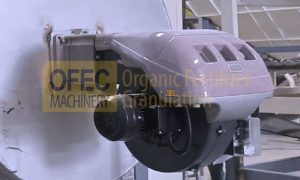
The OFEC combustion device offers two configurations:
Direct-Fired Type: Hot flue gases from combustion enter the dryer directly and contact the material. Thermal efficiency reaches 95%+ , suitable for organic fertilizer drying applications where flue gas impurities are not a concern. This is the mainstream choice for organic fertilizer production – highest thermal efficiency, lowest operating cost.
Indirect-Fired Type: Combustion flue gases pass through a heat exchanger to heat clean air, which then contacts the material. This prevents flue gas contamination of the product and is suitable for applications with higher purity requirements. The trade-off is slightly reduced thermal efficiency – every additional heat exchange step introduces additional heat loss.
The essence of selection is not “which is more advanced” – it’s “how high are your product purity requirements?” For the vast majority of organic fertilizer production, direct-fired is the most cost-effective choice.
4. Intelligent Control: More Than Just “Automatic Ignition”
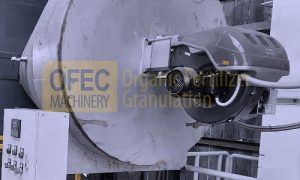
The PLC intelligent control system equipped on the OFEC combustion device does far more than “automatic ignition”:
- Automatic ignition: One-touch start, no manual intervention required
- Flame monitoring: Real-time combustion status detection – automatic fuel cut-off on flame-out
- Temperature regulation: Automatically adjusts heat output based on dryer demand
- Fault alarm: Immediate alerts on abnormal conditions to prevent escalation
The value of this system is not “saving the time it takes to push a button” – it’s “keeping the combustion process at its optimum condition.” Manual operation cannot precisely control the air-fuel ratio, while the PLC system adjusts in real time, ensuring fuel always burns under optimal conditions – the same fuel, more complete combustion; the same heat output, lower cost.
5. The Combustion Device Is the Dryer’s “Partner” – Not a “Subordinate”
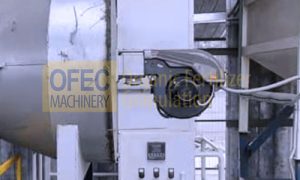
The relationship between the dryer and the combustion device is not “main unit” versus “accessory” – it’s a “partnership”:
- The dryer: Provides the “space” for drying – the drum, lifting flights, transmission system
- The combustion device: Provides the “power” for drying – heat, hot air, temperature
Without the combustion device, the dryer is just an empty rotating shell. Without the dryer, the combustion device has nowhere to release its heat. Together, they determine the efficiency, cost, and emissions of the drying stage.
When selecting a combustion device, it must be precisely matched to the dryer’s specifications and capacity requirements:
- Insufficient heat output: Dryer “starves” – capacity constrained
- Excessive heat output: Fuel wasted, pellets overheated
- Mismatched hot air temperature: Drying efficiency drops, energy consumption rises