




Drying, cooling, granulation, coating – every stage generates exhaust gases. These gases contain not just dust but also ammonia (NH₃), hydrogen sulfide (H₂S), volatile organic compounds (VOCs), and other components. If discharged untreated, complaints from nearby residents will come, environmental fines will arrive, and the worst-case scenario is production suspension for rectification.
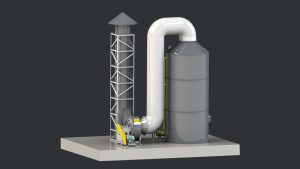
The OFEC spray tower product page lists its core parameters: counter-current gas-liquid contact design, packing layer + atomized spray dual-stage purification, dust removal efficiency >95%, acid gas removal rate 90%–99%, corrosion-resistant and high-temperature-resistant materials, fully automatic recirculation control. But the question worth exploring is not “what can this tower treat?” but rather “how does an efficient exhaust gas treatment system turn compliance risks into ‘treated air’?”
1. The “Three-Pronged Problem” of Organic Fertilizer Exhaust: Dust, Odor, and Acidic Gases
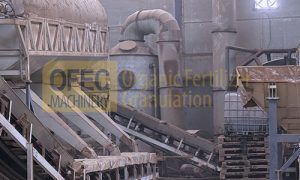
Exhaust gases from organic fertilizer production contain not just one problem, but three pollutants combined:
Dust. Exhaust from dryers, coolers, and granulators contains large quantities of fine particulate matter. These dust particles are not only a source of PM2.5 but also carry organic matter and nutrients – what escapes is pollution, and what drifts away is cost.
Odor. Ammonia and hydrogen sulfide released during organic fertilizer production are typical odor-causing gases. Ammonia has a strong pungent smell, while hydrogen sulfide has the characteristic “rotten egg” odor. Over 90% of complaints from nearby residents originate from “detecting an unpleasant odor.” Once complaints accumulate, environmental authorities intervene – starting with warnings, escalating to fines or even production suspension.
Acidic gases. Various acidic components are generated during drying and fermentation. These gases not only corrode equipment and shorten line lifespan but also cause long-term damage to surrounding soil and water bodies when emitted untreated.
A single spray tower addresses all three problems simultaneously.
2. Working Principle: Not Just “Spraying Water” – It’s a Precision Gas-Liquid Reaction
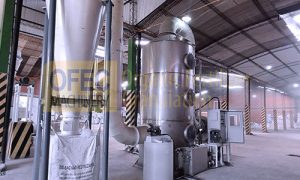
The OFEC spray tower employs counter-current gas-liquid contact design. Exhaust gas enters tangentially from the bottom of the tower, rapidly filling the inlet section under negative pressure from the induced draft fan, passing through a flow equalization zone before rising uniformly into the first-stage packing absorption section.
On the packing surface, pollutants in the exhaust gas (dust, ammonia, hydrogen sulfide, etc.) make full contact with the downward-flowing absorption liquid. Dust particles are wetted and captured by liquid droplets; acidic or alkaline gases undergo neutralization reactions with chemical agents in the absorption liquid (such as NaOH, H₂SO₄), forming soluble salts that flow with the liquid into the bottom recirculation tank.
Partially treated gas continues upward to the spray section. Here, the absorption liquid is atomized into fine droplets through specially designed nozzles, creating a dense spray zone that further increases gas-liquid contact area and enhances mass transfer efficiency. Simultaneously, the spray liquid cools the exhaust gas, reducing discharge temperature.
The top of the tower is equipped with a mist eliminator (baffle or wire mesh demister) to separate entrained liquid droplets from the gas stream, preventing “liquid carryover.” After multi-stage purification, the clean gas is discharged from the top into the atmosphere.
The entire circulation is driven by a recirculation pump, with absorption liquid reused continuously and periodically replenished or replaced in the recirculation tank to maintain stable absorption performance.
The key to this process is not “how much water is sprayed,” but “how large the gas-liquid contact area is.” The packing layer provides primary contact; the atomized spray provides secondary contact – the combination is what achieves high purification efficiency.
3. Core Advantages: Not Just “Usable” – It’s “Stable and Reliable”
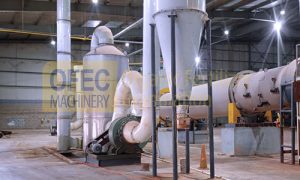
High purification efficiency. The combination of packing layer + atomized spray provides a massive gas-liquid contact area, with dust removal efficiency exceeding 95% and acid gas (NH₃, H₂S) removal rates of 90%–99%. This means the discharged air – whether in terms of dust concentration or odor intensity – stands firmly within compliance limits.
Corrosion-resistant and high-temperature-resistant. Organic fertilizer exhaust often contains acidic components and can reach temperatures of 80°C–120°C. OFEC spray tower shells and internal components can be fabricated from stainless steel, PP, or FRP (fiberglass-reinforced plastic) materials, fundamentally eliminating corrosion issues and ensuring long service life.
Simple operation and maintenance. The spray tower has a relatively simple structure with no complex rotating parts. Daily maintenance involves only checking whether nozzles are clogged, whether packing is intact, and whether circulating liquid concentration is normal – no specialized maintenance team is required; ordinary operators can handle it after brief training.
Fully automatic recirculation control. Absorption liquid circulation operates automatically via pump drive. Parameters such as liquid level, pH value, and spray pressure can be monitored and adjusted in real time through the control system – no frequent manual intervention is needed.
4. The Spray Tower Is Not a “Standalone” Unit – It’s Part of a Combined System
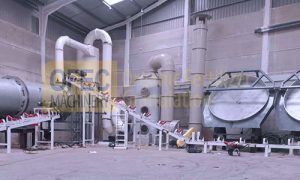
In organic fertilizer plant exhaust gas treatment systems, the spray tower often operates in combination with a pulse dust collector to form a “dry + wet” integrated process.
- Pulse dust collector (upstream) : Handles high-concentration dust as primary filtration
- Spray tower (downstream) : Handles residual dust, acid gases, and odors as fine purification
This “dry + wet” staged treatment approach enables phased treatment of pollutants with different particle sizes and properties – reducing the load on individual equipment while improving overall system stability and cost-effectiveness.
5. The Spray Tower Is Not a “Cost” – It’s an “Operating License”
In many regions, the presence and performance of exhaust gas treatment facilities already determine whether a plant can obtain a pollutant discharge permit, pass environmental impact assessments, and continue operations.
The investment in a spray tower may be several tens of thousands of dollars – but a single environmental fine can easily exceed USD 100,000, not to mention production stoppage losses, rectification costs, and brand reputation damage – the economics are clear.
More importantly, treated exhaust gas does not “disappear” – it becomes “compliant emissions.” A reliably operating spray tower enables the plant to produce with confidence and expand without worry – eliminating the constant fear of unexpected environmental inspections.