




1. Dust Is Not “Waste” – It’s “Raw Material in the Wrong Place”
Dust generated in organic fertilizer production has the same composition as the raw materials – containing organic matter, nitrogen, phosphorus, potassium, and other nutrients. It is not “creating pollution” – it is “losing value.”
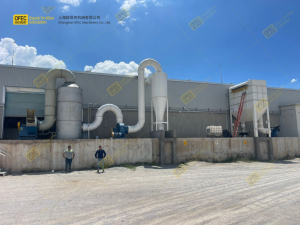
The pulse dust collector’s job is not “throwing dust away” – it’s “bringing dust back.” The collected dust is rich in organic matter and nutrients, and can be directly returned to the granulation or batching stage for reuse. This means the dust collector plays two roles simultaneously: environmental protection equipment + raw material recovery unit.
For a 50,000 t/y organic fertilizer plant, reducing dust emission concentration from 100 mg/m³ to 10 mg/m³ can recover tens to over a hundred tons of material annually – directly reducing raw material procurement costs by the same amount.
2. Pulse Jet Cleaning: No Shutdown, No Production Loss, No Extra Labor
The biggest problem with conventional dust collectors is shutdown during cleaning – when bags are clogged, the system must stop for cleaning, costing 30 minutes to an hour each time.
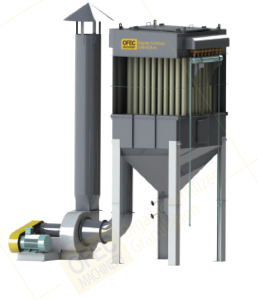
The OFECpulse dust collector uses pulse jet cleaning technology: compressed air is released instantaneously through pulse valves, passing through blow pipes with small nozzles to inject high-speed air into the filter bags. The resulting shock wave causes the bags to expand and vibrate rapidly, shaking off the accumulated dust. The cleaning process operates row by row in sequence, without interrupting continuous dust collection operations.
A PLC or differential pressure control system automatically triggers cleaning cycles based on bag resistance – no manual intervention required. This means: the dust collector runs automatically while operators focus on other tasks.
3. 99.9% Collection Efficiency: Above Compliance, Below Penalty Threshold
Emission standards for organic fertilizer plants are becoming increasingly stringent. In many regions, dust emission concentrations exceeding 30 mg/Nm³ can result in fines or even production suspension.
The OFECpulse dust collector employs advanced pulse jet cleaning technology, achieving collection efficiency exceeding 99.9%, with outlet emission concentrations consistently below 30 mg/Nm³ – firmly standing above the compliance line.
Compliance is not “close enough” – it’s “must achieve.” The price difference of a non-compliant dust collector may be entirely consumed by a single penalty.
4. Low-Pressure Operation: Saving Compressed Air Means Saving Electricity
A significant portion of pulse dust collector operating costs comes from compressed air consumption.
The OFECpulse dust collector uses low-pressure pulse technology (0.2–0.4 MPa) , minimizing compressed air usage. Optimized airflow distribution design reduces system resistance, lowering fan energy consumption.
Low pressure does not mean low efficiency. On the contrary, low-pressure pulse technology ensures effective cleaning while minimizing operating costs. For a 24/7 continuous production line, this difference can represent tens of thousands of dollars in electricity cost savings annually.
5. Modular Design: Flexible Installation – Any Site, Any Position
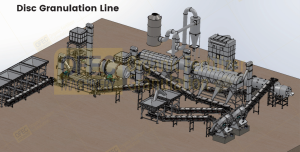
Factory space for organic fertilizer plants is often limited – the more compact the equipment layout, the better.
The OFECpulse dust collector features modular design with a small footprint, allowing flexible placement according to line layout. Top-access or side-door designs enable filter bag replacement without entering the equipment interior, reducing maintenance workload. Bag cages are treated with anti-corrosion coating for extended service life.