




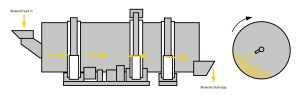
The OFEC coating machine product page lists its core parameters: drum diameter 0.8–2.5 meters, capacity 1–200 TPH, supports both liquid and powder coating agents. But the question worth exploring is not “what can this machine apply?” but rather “how is this final step transforming the value and market competitiveness of organic fertilizer?”
1. Coating Is Not Just “Adding a Layer” – It’s “Redefining the Product”
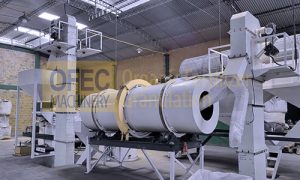
The coating machine’s task is not simply “spraying something on the pellet surface.” Its true value lies in altering the surface properties of the pellets – from physical characteristics to chemical performance, from appearance to functionality:
| Coating Type | Specific Function | Market Value |
| Anti-caking agent | Prevents pellet adhesion during storage and transport | Extended shelf life, reduced customer complaints |
| Slow-release/controlled-release coating | Regulates nutrient release rate to match crop uptake cycles | Improved fertilizer efficiency, higher product premium |
| Colorant | Gives pellets specific colors to meet market preferences | Enhanced brand recognition, competitive differentiation |
| Functional coating | Adds micronutrients or bioactive substances | Expanded product line, entry into premium markets |
A pellet without coating and a carefully coated pellet can have a market price gap of 15%–30%. The coating machine is not “nice to have” – it is a value-adding machine that upgrades “standard organic fertilizer” to “functional organic fertilizer.”
2. Anti-Caking: A Bag of Caked Fertilizer Means More Than Just Product Loss
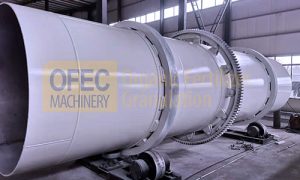
The biggest quality risk for organic fertilizer pellets during storage and transport is caking. The cause is simple: micro-cracks on pellet surfaces adsorb moisture in humid environments, forming “bridges” between pellets that gradually bond into hard lumps.
Consequences of caking:
- Cannot be applied properly: Caked fertilizer won’t flow through spreaders – farmers must manually break it apart – time-consuming and labor-intensive
- Uneven nutrient distribution: Caking leads to localized nutrient concentrations – causing root burn or seedling damage
- Customer complaints: One bag of caked fertilizer can turn a customer away for good
The coating machine forms a dense protective film on the pellet surface, effectively blocking moisture intrusion and fundamentally solving the caking problem. This seemingly simple function is actually protecting your brand reputation.
3. Slow-Release/Controlled-Release: From “Single Application” to “Precision Feeding”
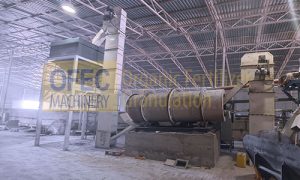
A core pain point of traditional organic fertilizer is uncontrollable nutrient release rates. After soil application, nutrients are released in large quantities over a short period – crops cannot absorb them quickly enough, leading to leaching. By the mid-to-late growth stage, nutrients are depleted.
Coating slow-release technology wraps a controlled-release membrane around each pellet, allowing nutrients to be released at a programmed rate – matching the crop’s absorption rhythm. A single application can meet the entire growth cycle’s nutrient requirements.
This value is particularly significant for cash crops (fruits, vegetables, flowers, medicinal herbs): fewer applications, reduced labor costs, higher fertilizer efficiency, improved crop quality. Coated slow-release organic fertilizer typically commands a market price 20%–50% higher than standard organic fertilizer.
4. Appearance: Invisible Function, Visible “Quality Tier”
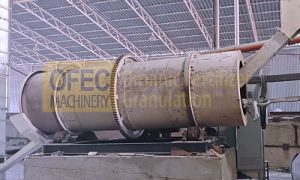
There is a widely overlooked fact in the organic fertilizer industry: pellet appearance directly influences end-user purchasing decisions.
Pellets with uniform color, smooth surface, and consistent size convey “quality” to farmers and distributors. Pellets with mottled color and rough surfaces, even with nutrient content meeting standards, are easily labeled as “low-end products.”
The coating machine, through colorants and polishing action, gives pellets a more uniform, glossy, professional appearance. The value of this appearance enhancement is not just “looking good” – it’s a direct expression of brand premium capability.
5. The “Hidden Return” of Coating: One Investment, Ongoing Returns
Some plants view coating machine investment as “extra expense.” But from a full-lifecycle perspective, the returns far outweigh the investment:
| Return Dimension | Specific Performance | Quantitative Reference |
| Product premium | Coated products command higher prices | Price increase of 15%–30% |
| Customer retention | Consistent quality reduces complaints | Increased repeat purchase rate |
| Market expansion | Access to premium market segments | Extended product line |
| Brand value | Competitive differentiation | Long-term brand equity accumulation |
The coating machine typically achieves payback within 6–12 months – for lines with annual capacity exceeding 10,000 tons, this period is even shorter.