




1. Mixing Uniformity: The Granulator’s “Achilles’ Heel”
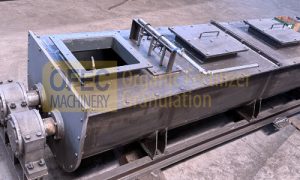
The granulator’s feed requirements are never “good enough is fine.” If material entering the granulator has high nutrient concentration in one area and low concentration in another, the pellets produced will have uneven nutrient distribution.
The cascade effect of uneven mixing:
| Problem | Direct Consequence | Final Impact |
| Uneven nutrient distribution | Fluctuating nutrient content in pellets | Product fails quality inspection |
| Uneven moisture distribution | Localized over-wet or over-dry areas | Reduced pelletization rate |
| Uneven additive distribution | Functional ingredients missing in some areas | Product functionality compromised |
| Undispersed material lumps | Large lumps enter granulator | Equipment blockage, shutdown |
The mixer’s job is not “to stir material together” – it’s “to distribute every component of every batch uniformly into every pellet that will be formed.” This requirement is a full dimension beyond simply “mixing well.”
2. Twin-Shaft vs. Disc: Not “Which Is Better” – “Which Fits Your Production Rhythm”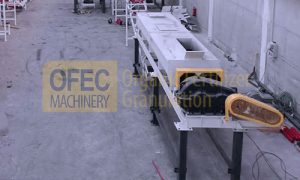
OFEC’s two mixer types correspond to two entirely different production rhythms.
Twin-Shaft Mixer (Continuous):
- Two parallel shafts rotating synchronously in opposite directions – creating convection, shearing, and diffusion movements within the housing
- Designed for continuous large-scale production – material continuously enters and exits – no stoppages
- High mixing uniformity, fast efficiency – suitable for scaled lines with annual capacity of 10,000–50,000+ tons
- Blades made of wear-resistant, non-stick materials – easy replacement when worn
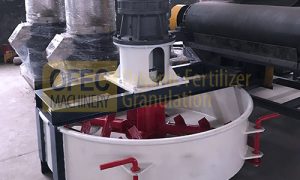
Disc Mixer (Batch):
- Vertical disc structure – mixing disc and arms work together to create multi-dimensional mixing
- Designed for intermittent small-batch production – mix one batch, discharge, clean, mix the next
- Discharge outlet at the bottom of the disc – fast and complete discharge
- Easy cleaning for product changeover – ideal for projects with frequent formulation changes and multiple product types
The essence of selection is not “which is more advanced” – it’s “which fits your production rhythm.” If your formulation is relatively fixed and requires continuous output – the twin-shaft mixer is the right choice. If you need to switch formulations frequently and produce multiple products in small batches – the disc mixer’s flexibility and easy-clean characteristics are irreplaceable.
3. Sealing and Anti-Sticking: Two Easily Overlooked “Critical Details”
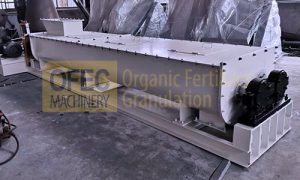
The mixer product page highlights two design features that may seem minor but determine long-term equipment performance:
Tight sealing: Organic materials are moist and dusty. Poor housing sealing allows dust to escape – contaminating the workshop environment, endangering worker health, and representing material loss. Every kilogram of escaped dust is semi-finished product that has already gone through fermentation, crushing, and batching.
Wear-resistant, non-stick blades: Organic materials are sticky. Conventional blades quickly become coated with material, losing mixing efficiency. OFEC blades are made of wear-resistant, non-stick materials with a simple, well-designed structure – easy replacement when worn. This design means the equipment does not gradually “fail” due to blade coating – mixing efficiency remains stable over the long term.
These two details determine whether a mixer “still performs after three years” or “starts degrading after three months.”
4. Mixing Is a “Precondition” for Granulation – Not a “Supporting Process”
In the organic fertilizer production process flow, mixing sits in a critical position after crushing and before granulation:
Fermented organic materials → Crushing → Mixing → Granulation → Drying → Cooling → Screening → Packaging
This position determines the mixer’s influence – it receives crushed material and outputs the “final formulation” about to enter the granulator. If mixing is poor, crushing is wasted and granulation is compromised.
The mixer’s uniformity determines the upper limit of the granulator’s achievable pelletization rate. If material is not uniformly mixed, even the most advanced granulator cannot reach full performance. A mixer delivering uniform output and stable operation keeps the granulator’s pelletization rate at its highest achievable level.