




1. Crushing Is the “Foundation” of Granulation – If the Foundation Is Weak, Everything Above It Will Be Flawed
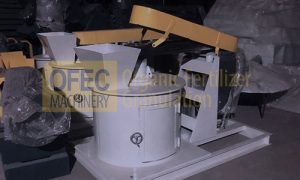
Organic fertilizer granulation has a clear requirement for raw material particle size: feed particle size should be controlled below 5mm. Oversized material entering the granulator creates a cascade of problems:
| Problem | Direct Consequence | Chain Reaction |
| Oversized material fails to granulate | Reduced pelletization rate | Increased returns, capacity waste |
| Uneven particle size | Reduced mixing uniformity | Nutrient fluctuations in product |
| Large particles cause equipment wear | Accelerated wear of internal granulator components | Increased maintenance costs |
| Material retention in granulator | Increased risk of blockage | Forced shutdown for cleaning |
The crusher’s value is not in how “advanced” it is – it’s in its ability to “clear the path” for all subsequent processes. A crusher delivering uniform output particle size and stable operation can improve the granulator’s pelletization rate by 10%–20%, increase the dryer’s thermal efficiency, and enhance the screener’s grading precision – the performance of a single crusher affects the entire production line.
2. Vertical vs. Horizontal: Not “Which Is Better” – “Which Fits Your Material”
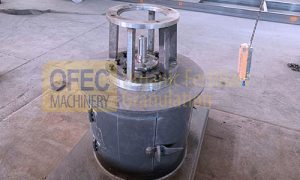
OFEC offers vertical and horizontal chain crushers – these two models are not differentiated by “advanced” versus “obsolete,” but by precise matching to different material characteristics.
Vertical Chain Crusher (Single Rotor):
- Material enters from the top, impacted by high-speed rotating chains, colliding with the housing and other particles for size reduction
- Compact structure, small footprint – ideal for space-constrained facilities
- Suitable for organic materials with lower moisture content and less fiber
- Typical scenario: Highly composted organic materials that have undergone preliminary drying
Horizontal Chain Crusher (Dual Rotor):
- Two horizontally arranged parallel rotors, each with identical chain assemblies
- Material receives double impact from two sets of high-speed rotating chains – more thorough crushing
- Anti-clogging design – particularly suitable for high-moisture organic materials
- Typical scenario: Fresh organic materials directly from the fermentation trough with higher moisture content
Selection decision logic: If raw material moisture is consistently below 20%, the vertical model is sufficient. If moisture fluctuates significantly and frequently exceeds 25%, the horizontal dual-rotor design is the safer choice – it’s not “better” – it’s “more tolerant of moisture.”
3. Chains vs. Blades: A Detail That Determines Whether the Machine Can Handle Your Material
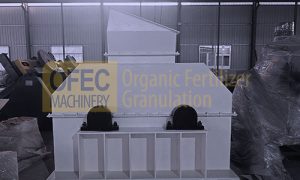
One key feature of the OFEC crusher is the interchangeability of chains and blades. This seemingly minor detail is actually the core factor determining whether the crusher can adapt to different materials.
- Chain mode: Suitable for conventional organic materials – crushing through high-speed impact
- Blade mode: Suitable for high-fiber, high-toughness materials (straw, rice husks, etc.) – crushing through cutting action
Why is this design important? Organic fertilizer raw materials vary widely – different batches of livestock manure have different fiber content, and straw hardness varies by season. A machine that “only crushes one way” struggles when raw materials change. The interchangeable chains and blades give the crusher flexibility to adapt as raw materials vary.
4. Output Particle Size ≤5mm: This Number Sets the Granulator’s “Ceiling”
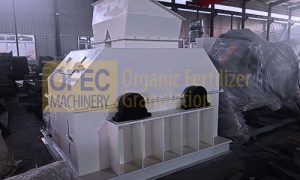
The OFEC crusher delivers output particle size controlled at ≤5mm. This is not an arbitrary number – it directly corresponds to the granulator’s feed particle size requirement.
- Particle size ≤5mm: Granulator operates normally, stable pelletization rate
- Particle size >5mm: Granulator pelletization rate drops, returns increase, capacity wasted
The crusher’s output particle size determines the granulator’s “ceiling.” No matter how advanced the granulator is, if the feed contains 10mm lumps, the pelletization rate will suffer. A crusher delivering uniform, stable output particle size is the prerequisite for the granulator to achieve full performance.
5. The “Hidden Costs” of Inadequate Crushing: Uneven Particle Size – the Entire Line “Pays the Price”
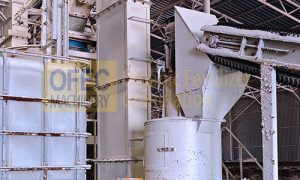
Problems in the crushing stage often don’t manifest at the crusher itself – they appear progressively at the granulator, dryer, and screener.
| Crushing Problem | Effect on Granulator | Effect on Dryer | Effect on Screener |
| Oversized output | Reduced pelletization rate, increased returns | Uneven drying of large particles | Large particles screened out, increasing return circulation |
| Uneven output particle size | Inconsistent pellet size | Fine particles over-dried, large particles under-dried | Reduced screening efficiency, higher return ratio |
| Frequent clogging | Granulator feed interrupted | Dryer runs idle | Entire line forced to slow down |
Problems in the crushing stage ultimately become “costs” for the entire production line – more returns, higher energy consumption, lower capacity, more frequent stoppages. A crusher delivering stable output particle size and reliable operation can increase the entire line’s effective capacity by 10%–20%.