




The OFEC automatic batching system product page lists its technical specifications: 2–8 material types, dynamic continuous weighing, accuracy ≤ ±1%, single-line capacity 1–30 t/h. But the question worth exploring is not “what materials can it batch?” but rather “how much does a 1% improvement in batching accuracy change the destiny of the entire production line?“
1. Batching Accuracy: A 1% Difference Can Be the Line Between Profit and Loss
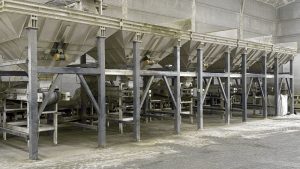
Organic fertilizer nutrient content (N/P/K, organic matter) directly determines product market value. And the final nutrient content is determined by the proportion of each raw material in the batching stage.
- Accuracy ±1%: Error per ton ≤10 kg per material
- Accuracy ±3% (common with manual batching): Error per ton ≤30 kg per material
Consider nitrogen: if the formulation requires 3% nitrogen content, and batching error causes underfeeding of nitrogen source, the finished product may drop to 2.7% nitrogen – falling outside the qualified product standard. This batch must either be sold at a discount or reprocessed. Every ton represents direct loss.
The scaling effect: On a 50,000 t/y line, a 1% accuracy difference means 500 tons of raw material are mis-batched annually. That’s not “close enough” – it’s real cost.
2. The Biggest Challenge in Organic Fertilizer Batching: Materials That “Don’t Behave”
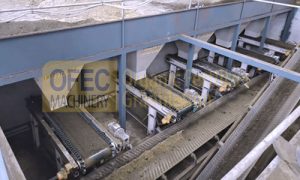
Unlike the uniform powder materials in the chemical industry, organic fertilizer batching faces a fundamental challenge: widely varying material characteristics.
| Material Type | Typical Examples | Flowability | Moisture Content | Batching Difficulty |
| Organic materials | Fermented manure, biogas residue | Poor | 25%–40% | Prone to clogging and arching |
| Straw powder | Corn straw, rice husk powder | Moderate | 10%–20% | Long fibers, prone to bridging |
| Inorganic nutrients | Urea, MAP, MOP | Good | <5% | Prone to moisture absorption and caking |
| Conditioners | Bentonite, vermiculite | Poor | 5%–15% | Significant density variation |
Material bridging is the most common batching system failure. High-moisture organic materials tend to form arches above the discharge opening – material flow stops completely. When a blockage occurs, the entire production line must stop for cleaning.
OFEC’s batching system features “optimized hopper and feeder design to prevent material bridging” – this isn’t just a feature description. It’s a precise response to the most frequent failure mode in organic fertilizer plants. Proper anti-clogging design can increase effective line operating time from 85% to over 95%.
3. Dynamic Continuous Weighing vs. Static Batch Weighing: Two Paths, Worlds Apart
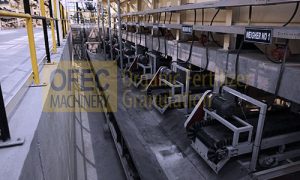
Organic fertilizer batching follows one of two technical paths:
Static Batch Weighing: Each material is weighed individually and then combined. Advantages: simple equipment, lower investment. Disadvantages: long batching cycles – the system must wait for each material to be weighed sequentially; continuous feeding is impossible.
Dynamic Continuous Weighing: Real-time weighing and adjustment during belt conveying. This is the path OFEC has adopted. The key advantage is uninterrupted flow – the granulator never waits for batching to finish; raw materials feed continuously.
Capacity gap: Static batch systems typically require 5–10 minutes per cycle; dynamic continuous systems respond in seconds, tracking the setpoint in real time. On a 50,000 t/y line, this difference translates into hundreds of additional hours of productive time annually.
4. Manual Batching vs. Automatic Batching: Not an “Efficiency” Question – It’s a “Survival” Question

The OFEC product page includes a comparison table covering six dimensions: accuracy, recipe adjustment, efficiency, labor intensity, product quality, and total cost.
The conclusion is clear: manual batching suits small workshops processing thousands of tons per year; automatic batching is the only viable choice for scaled production.
- Manual batching error of 3%–5%: At 50,000 t/y, this means 1,500–2,500 tons of mis-batched material annually – not “acceptable”
- Manual batching cannot adjust in real time: Formulation changes require re-weighing each material – taking hours; automatic batching completes recipe switching in minutes
- Manual batching labor costs: A 50,000 t/y line requires 4–6 people per shift; automatic batching requires 1 person for monitoring
The one-time investment in an automatic batching system is typically recovered within 6–12 months through reduced waste, labor savings, and increased throughput.
5. The Batching System Is the Production Line’s “First Quality Gate”
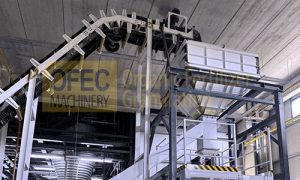
In Total Quality Management (TQM), a fundamental principle is: quality is not inspected into the product – it’s built into the product. In organic fertilizer production, the batching system is the first stop on this principle.
The granulator cannot “correct” a formulation error – it can only granulate the incorrectly batched material. The dryer cannot “adjust” nutrient content – it can only dry incorrectly batched pellets. The screener cannot “select” correctly batched pellets – it can only classify by particle size.
The batching system’s accuracy sets the “ceiling” for all downstream processes. If batching is wrong, everything that follows is wrong.