




1. Batching System: Accuracy Determines Product Consistency
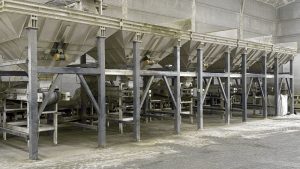
The batching system is the “first checkpoint” of the production line. Its role is not simply “feeding material” but “precisely feeding material according to formulation.”
Selection Criteria:
- Number of ingredients: Organic fertilizer formulations typically involve 2–8 materials (organic matter, conditioners, micronutrients, etc.). Select a batching system with sufficient channels based on formulation complexity.
- Accuracy requirements: Dynamic continuous weighing accuracy should be better than ±1%. Insufficient accuracy leads to batch-to-batch nutrient fluctuations, directly affecting product pass rates.
- Material characteristic adaptation: Organic materials have high moisture content and variable flowability – hoppers and feeders require anti-clogging design.
Common Mistake: Choosing manual batching to save costs. Manual batching errors typically range from 3%–5% or higher, with poor batch-to-batch consistency. For scaled production, the investment in an automatic batching system is usually recovered within 6–12 months through reduced waste and rework.
2. Crushing & Mixing: Building the Foundation for Granulation
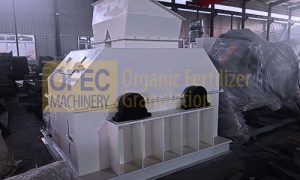
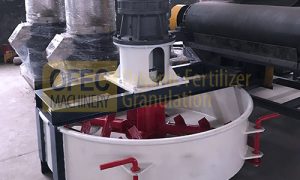
The granulator’s pelletization rate and pellet quality depend heavily on the particle size, moisture content, and mixing uniformity of the feed material. If crushing and mixing are inadequate, even the most advanced granulator will underperform.
Crusher Selection Criteria:
- Material characteristics: Fermented organic materials typically have high moisture and high fiber content. Horizontal chain crushers with dual‑rotor design resist clogging when processing high‑moisture materials – making them the better choice for organic fertilizer applications.
- Output particle size: Granulation typically requires feed particle size ≤5 mm. Inconsistent crusher output directly affects pelletization rate and pellet appearance.
- Capacity matching: The crusher’s throughput must match the overall line capacity to avoid becoming a “bottleneck process.”
Mixer Selection Criteria:
- Production mode: Continuous large‑scale production → twin‑shaft mixer (high uniformity). Intermittent small‑batch production or frequent formula changes → disc mixer (easy cleaning and quick changeover).
- Sealing and anti‑sticking: Organic materials are moist and sticky. The mixer housing must be tightly sealed to prevent dust leakage, and blades should be made of wear‑resistant, non‑stick materials.
3. Drying & Cooling: Gatekeepers of Pellet Quality
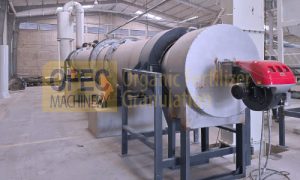
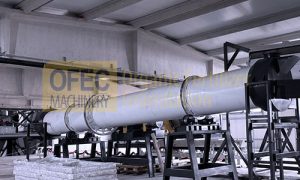
Pellets exiting the granulator typically have moisture content of 20%–35% and must be dried to meet storage standards (≤15%). The drying and cooling stages directly determine pellet strength, appearance, and storage stability.
Dryer Selection Criteria:
- Heat source selection: Choose from fuel oil, natural gas, coal, or biomass based on local energy availability. Heat source cost is a critical long‑term operating variable.
- Customized lifting flights: Different organic materials (viscosity, moisture, heat sensitivity) require different lifter designs. Customization maximizes thermal efficiency.
- Special consideration for bio‑organic fertilizers: Beneficial microbes are temperature‑sensitive. Low‑temperature drying processes (below 80°C) are required to maintain viable microbial counts.
Cooler Selection Criteria:
- Cooling method: Counter‑current air cooling provides the highest cooling efficiency and lowest discharge temperature.
- Capacity matching: The cooler’s throughput must match the dryer’s output to prevent inadequate cooling, which leads to moisture regain and caking.
4. Screening & Recycling: Minimizing Waste, Maximizing Efficiency
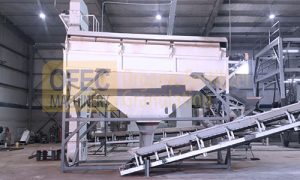
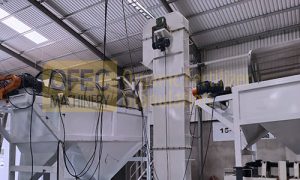
Screening separates finished pellets from rejects (fines and oversize). This stage directly affects product specification uniformity and raw material utilization.
Selection Criteria:
- Screening precision: Screen mesh size should be customized based on target pellet diameter. Organic fertilizer pellets typically fall in the 1–6 mm range.
- Anti‑clogging design: Organic materials are moist, making screens prone to clogging. A cleaning brush device effectively maintains screening efficiency.
- Return system: Fines and oversize from screening should be returned to the granulator or crusher via conveying systems, forming a closed loop. Every 5% reduction in recycle rate saves thousands of tons of returns annually on a 50,000 t/y line – significantly reducing energy and labor costs.
5. Coating & Packaging: The Final Value‑Adding Steps
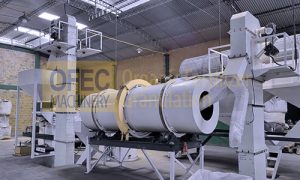
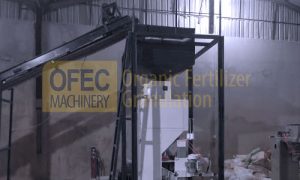
Coating and packaging are the last two stages before finished products leave the factory – directly affecting product presentation and logistics efficiency.
Coating Machine Selection Criteria:
- Liquid/powder dual‑use: Must support both liquid coating agents (anti‑caking oils) and powder coating agents (diatomaceous earth, kaolin, etc.).
- Coating uniformity: Strip‑shaped lifting flights ensure thorough granule tumbling and uniform coating coverage.
Packaging Machine Selection Criteria:
- Packaging format: Choose from ton bags, open‑mouth bags, or valve bags based on target market requirements.
- Capacity matching: Single‑scale suitable for medium output; double‑scale alternates or operates in parallel – significantly improving packaging efficiency.
- Automation extension: Optional automatic palletizing system reduces labor and improves efficiency.
The Underlying Logic: From “Individual Equipment” to “Line-Wide Integration”
The most common mistake in auxiliary equipment selection is evaluating each piece in isolation – choosing the best batching system, the fastest crusher, the largest dryer – only to find they don’t work together.
The correct selection sequence:
- Set capacity first: Define target annual or hourly output – this is the benchmark for all equipment selection.
- Define the process: Determine the process flow (wet/dry, hot/cold granulation) based on material characteristics and product positioning.
- Select equipment: Within the process framework, determine specifications and parameters for each stage.
- Perform integration: Verify capacity alignment, conveying compatibility, and control interlocking across all equipment.
Scale-to-Configuration Reference:
| Production Scale | Recommended Configuration Approach |
| Small (<10,000 t/y) | Modular equipment – minimize initial investment |
| Medium (10,000–50,000 t/y) | Semi‑automated line – balance efficiency and cost |
| Large (>50,000 t/y) | Fully automated equipment – intelligent control systems |
Summary
The granulator is the “heart” of the production line. The auxiliary equipment is the “blood vessels” and “organs” throughout the body. No matter how strong the heart is, if the blood vessels are blocked and organs are out of sync, the entire production line cannot function efficiently.
The core principle of auxiliary equipment selection is simple: adopt a line‑wide perspective – ensure every piece of equipment is placed correctly and functions properly within the system. Equipment is not isolated; it is an interconnected system. Focus on the “line,” not just the “point” – this is how you avoid the trap of “excellent equipment, frustrating line performance.”