


Shanghai OFEC Machinery Co., Ltd.

Shanghai OFEC Machinery Co., Ltd.

E-mail: david@emccindustry.com

Contact Us

Lowering Recycle Ratios to Drive Thermal Efficiency in Pan Granulation Infrastructure

Home / News / blog
SHANGHAI (June 2026) — In a newly published technical white paper, OFEC analyzes the often-overlooked relationship between granulation recycle ratios and downstream thermal energy consumption. In fertilizer manufacturing, the percentage of off-spec granules returned to the mixer for re-granulation—the recycle rate—directly affects a plant’s return on investment (ROI).

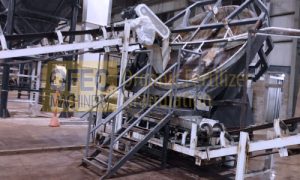
Data compiled from operational plants reveals that OFEC’s high-precision disc granulators achieve an exceptionally low recycle rate (10%-15%) and a granulation rate up to 95%. Because the majority of the powdery raw material blend forms into pellets in a single pass, the need for continuous material recirculation is minimized. This significantly reduces the wet material load sent to downstream rotary dryers. By eliminating massive recycle loops, the system slashes overall fuel and power consumption in the drying and cooling phases by up to 25%, providing an efficient solution for commercial fertilizer producers.

MASS BALANCE & ENERGY EFFICIENCY AUDIT
METRIC OVERVIEW   MEASURED IMPACT PERFORMANCE
Single-Pass Granulation Efficiency Up to 95% output rating   
System Recycle Rate Boundaries Tightly bounded below 10% – 15%
Downstream Fuel Reduction  Verified 25% thermal energy savings

Furthermore, the white paper outlines the cascading operational cost benefits of this single-pass efficiency. A lower volume of recycled fines flowing backward through the conveyor network reduces friction wear and dust generation along the entire material handling line. This minimizes belt fatigue, protects bearing blocks, and lowers the frequency of preventive replacement cycles across the plant. The report supports these findings with mathematical thermodynamic models showing how maintaining a tight, steady, single-pass mass balance prevents temperature drops inside the core pellet core, optimizing drying times by up to 18 minutes per production run. This balance eliminates moisture-trapping zones inside the pellet core, resulting in a consistent structural density that prevents degradation during bulk vertical storage.


Scroll to Top