




Spray Tower
Product Overview
During organic fertiliser production, exhaust gases discharged from dryers, coolers, granulators, and other equipment often contain large amounts of dust, water vapour, acid gases, and malodorous components. If released untreated, these gases not only cause air pollution but may also trigger complaints from nearby residents and penalties from environmental authorities. Therefore, installing an efficient and reliable exhaust gas purification system is an essential step for organic fertiliser plants to achieve clean production and sustainable development.
Working Principle
The OFEC Spray Tower operates on the principle of gas‑liquid mass transfer and chemical reaction. Exhaust gas enters the tower tangentially through the bottom inlet and, under negative pressure from the induced‑draft fan, rapidly fills the inlet section. It then passes through a flow‑equalisation zone before rising uniformly to the first‑stage packing absorption section.
On the packing surface, pollutants in the exhaust gas (such as dust, ammonia, hydrogen sulphide, etc.) come into full contact with the absorption liquid flowing downward. Dust particles are wetted and captured by liquid droplets, while acid or alkaline gases undergo neutralisation reactions with chemical agents in the absorption liquid (e.g., NaOH, H₂SO₄), forming soluble salts that flow with the liquid into the circulation tank at the bottom.
Partially treated gas continues rising to the spray section. Here, the absorption liquid is atomised through specially designed nozzles into a large number of fine droplets, creating a dense spray zone that further increases gas‑liquid contact area and enhances mass transfer efficiency. Simultaneously, the spray liquid cools the exhaust gas and reduces its discharge temperature.
The uppermost section of the tower is equipped with a mist eliminator (baffle plates or mesh demister) to separate entrained liquid droplets from the gas stream, preventing “carryover” of liquid. After multi‑stage purification, the clean gas is finally discharged to the atmosphere from the top of the tower.
The entire circulation process is driven by a recirculation pump. The absorption liquid can be reused and is periodically replenished or replaced in the circulation tank to maintain stable absorption performance.
Features and Benefits
High Purification Efficiency
Corrosion‑Resistant and High‑Temperature Resistant
Simple Operation and Maintenance
Automatic Replenishment and Intelligent Control
Flexible Adaptability
Low Energy Consumption
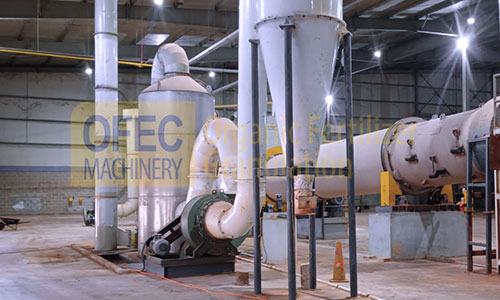
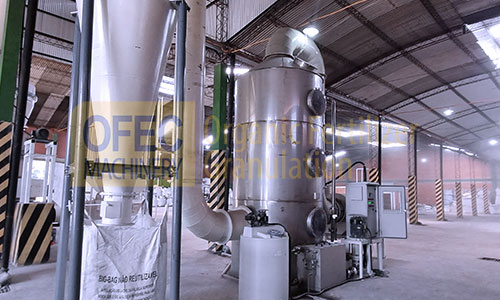
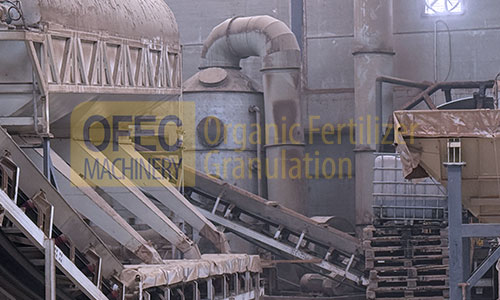
Industry Solution for Organic Fertiliser Exhaust Gas Treatment
Spray tower purifies high‑temperature, humid exhaust from drying/cooling and dust‑laden gases from granulation/coating. Optional pulse dust collector pre‑treatment for heavy dust loads.
Key Benefits:
● Meets emission standards – removes particulates, ammonia, H₂S
● Eliminates odours – improves plant and surrounding air quality
● Protects equipment – reduces dust buildup, extends service life
● Dry + wet combined process for tighter limits (optional)
● Low maintenance – standard components, simple routine checks
Resources
The Organic Fertilizer Plant’s “Odor Neutralizer” – Turning Compliance Risks into “Treated Air”
On an organic fertilizer production line, the granulator determines “whether