




Rotary Drum Granulator
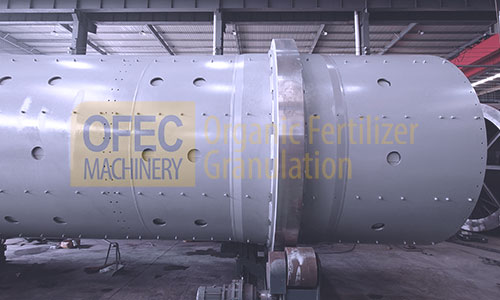
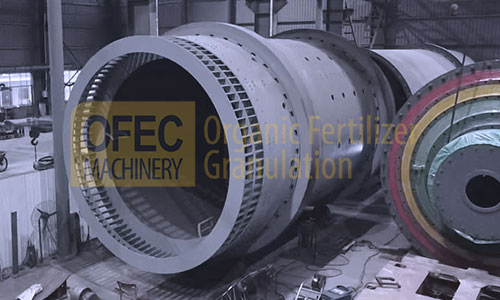
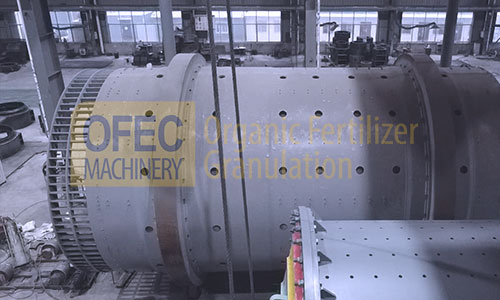
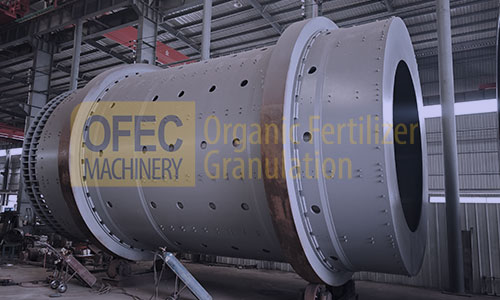
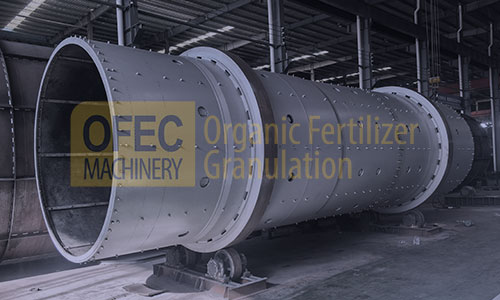
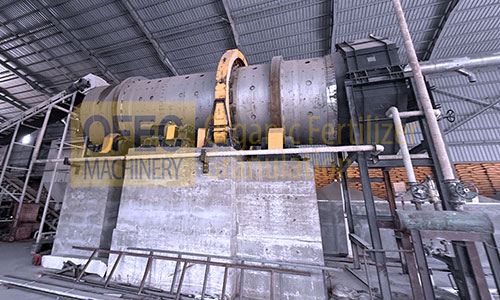
The OFEC drum granulator is the core granulation equipment for organic fertilizer production lines. Adopting a wet agglomeration process, it is specifically designed for large‑scale manufacturing of organic fertilizers and the resource utilization of organic waste, with a processing capacity ranging from 1 to 200 TPH.
Product Overview
Equipment Components
A – Shell: The core working part where granulation takes place
B – Feed Chute: Continuously delivers powdered organic material into the drum
C – Discharge Chute: Discharges finished organic fertilizer pellets
D – Support Roller Assembly: Supports the rotating drum
E – Drive Unit: Drives the drum rotation (pinion and gear ring)
F – Guard Cover: Safety protection
G – Spray Pipe Assembly: Sprays water, steam, or organic binders
H – Tyre Ring: Works with support rollers to support the drum
I – Gear Ring: Drive component
J – Pinion: Drive component
- Shell: The core working part where granulation takes place
- Feed Chute: Continuously delivers powdered organic material into the drum
- Discharge Chute: Discharges finished organic fertilizer pellets
- Support Roller Assembly: Supports the rotating drum
- Drive Unit: Drives the drum rotation (pinion and gear ring)
- Guard Cover: Safety protection
- Spray Pipe Assembly: Sprays water, steam, or organic binders
- Tyre Ring: Works with support rollers to support the drum
- Gear Ring: Drive component
- Pinion: Drive component
Working Principle
In operation, powdered organic material is continuously fed into the inclined rotating drum through the feed inlet. As the drum rotates, the material is carried up the wall and then tumbles back down, creating a continuous rolling motion. Simultaneously, water, steam, or organic binders are sprayed through the liquid distribution system, causing the moistened fines to collide, adhere, and agglomerate into clusters. The tumbling action rounds the agglomerates into uniform spherical organic fertilizer pellets.
To prevent material from sticking to the inner wall, the drum is lined with flexible rubber strips secured by steel bars and bolts. Breathing holes are placed behind each rubber strip and through the shell. When the drum rotates to the top, the rubber strips sag under their own weight and that of any adhered material, causing the buildup to crack and fall off – effectively self‑cleaning the drum without the need for traditional scrapers.
Applicable Materials
The OFEC Drum Granulator is suitable for granulating various organic fertilizer feedstocks. Typical materials include:
Material Category | Typical Examples |
Fermented Organic Materials | Fermented livestock manure (pig, chicken, cow, etc.), humic acid, bio‑organic fertilizer, biogas residue |
Organic Wastes | Straw powder, peat, distiller’s grains, sugar filter mud, municipal sludge |
Material Category
Typical Examples
Fermented livestock manure (pig, chicken, cow, etc.), humic acid, bio‑organic fertilizer, biogas residue
Features and Benefits
High Capacity
High Pellet Strength
Rugged Construction
High Efficiency
Material Options
Self‑Cleaning Wall
Drum Granulator vs. Disc Granulator
Aspect | Drum Granulator | |
Scale | Large‑scale, continuous operation | Small‑scale, flexible production |
Single‑Unit Capacity | 1–200 t/h | 0.5–8 t/h |
Equipment Investment | Higher | Lower |
Operating Cost | Higher, but lower unit cost at scale | Lower |
Material Adaptability | Wide range | High‑moisture, high‑viscosity organic materials |
Pellet Shape | Spherical/oval, high strength | Spherical, well‑rounded, moderate strength |
Operation & Maintenance | Highly automated | Simple, intuitive, easy maintenance |
Production Flexibility | Lower, suited for long‑term fixed products | High, quick formula and parameter changes |
Environmental Control | Closed system, easy dust control | Open system, dust control more challenging |
Scale
Equipment Investment
Operating Cost
Material Adaptability
Wide range
Resources
Have You Calculated These “Hidden Costs” in Large-Scale Organic Fertilizer Production?
In the organic fertilizer industry, when a project scales from